


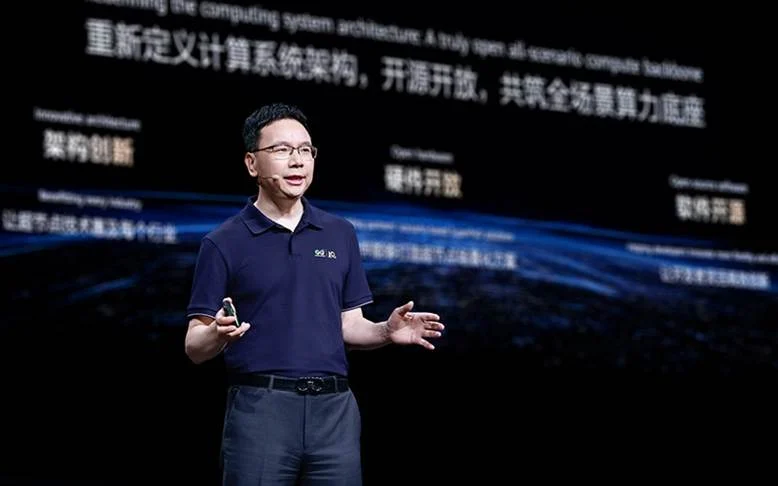
HUAWEI CONNECT 2025 saw Yang Chaobin, Huawei’s Director of the Board and CEO of the ICT Business Group, launch the tech giant’s new SuperPoD architecture, as well as multiple related products including cards, modules, servers and clusters. In his keynote speech titled ‘A Solid Computing Backbone for All Scenarios: New SuperPoD Architecture, Open Source and Open Systems’, Chaobin said the company aims to collaborate with more industry players to create a solid computing backbone for all scenarios using this new architecture.
He explained: “Huawei has developed the groundbreaking SuperPoD architecture based on our UnifiedBus interconnect protocol. This architecture deeply interconnects physical servers so that they can learn, think and reason like a single logical server. This has created a new paradigm for large-scale compute that is more efficient, reliable and scalable.
“Using SuperPoD, we will be able to advance innovation under our Ascend umbrella and develop a full lineup of SuperPoD products,” Chaobin continued. “These products will provide compute for large data centres, enterprise data centres and small-size workstations, and so, SuperPoD technology will benefit every industry. At the same time, we are committed to our open-hardware and open-source-software approach that will help more partners develop their own industry-scenario-based SuperPoD solutions. This will accelerate developer innovation and foster a thriving ecosystem.”
Unleashing the potential of cluster-based compute with the SuperPoD architecture
As AI continues to evolve, demand has risen for effective compute and lower latency. Historically, computing clusters are scaled by stacking servers, but the larger a cluster gets, the lower its compute utilisation becomes. Larger clusters also suffer from more frequent interruptions during model training.
Huawei’s new SuperPoD architecture is based on its UnifiedBus protocol, which delivers a number of notable new features, including strong resource pooling, scaling and long-term stability. This architecture enables high-bandwidth, low-latency interconnection between computing and data storage units, and its unified protocols and memory addressing allow effective compute to scale linearly with the cluster scale, which ultimately improves cluster reliability.
Over 300 Atlas 900 A3 SuperPoD units, have already been shipped in 2025, which have been deployed for more than 20 customers from multiple sectors, including the Internet, finance, carrier, electricity and manufacturing sectors.
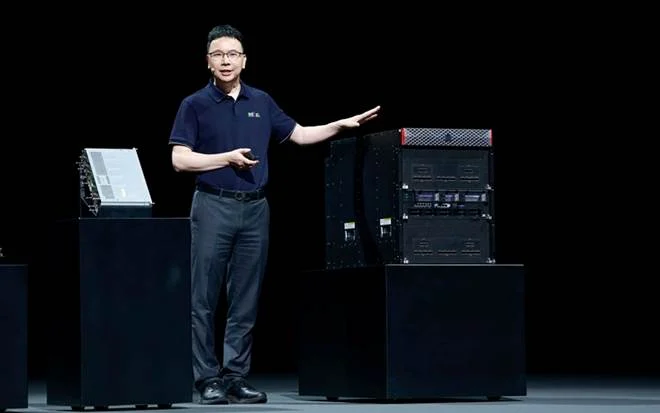
Huawei also launched a number of new products based on UnifiedBus and the SuperPoD architecture at this year’s event in Shanghai. These included the fully liquid-cooled Atlas 950 SuperPoD server for data centres, the air-cooled Atlas 850 and Atlas 860 SuperPoD servers, the next-generation Atlas 350 card and the TaiShan 950 SuperPoD server, the industry’s first SuperPoD server for general-purpose computing.
The Atlas 950 SuperPoD is billed as being the optimal solution for ultra-large-scale AI computing tasks. It combines a series of innovations the company has made in components, protocols, algorithms and optoelectronic technologies, and uses an orthogonal architecture to achieve cableless electrical interconnection. Its floating blind-mate liquid-cooling connector ensures zero coolant leaks and the unique materials and techniques used by its cooling system deliver double the reliability of similar liquid-cooled optical modules.
In addition, its innovative UB-Mesh recursive direct-connect topology network architecture supports intra-board, cross-board and inter-rack full-mesh NPU interconnection. It can be scaled up in steps of 64 NPUs and supports up to 8,192 NPUs interconnected without convergence.
The Atlas 850 SuperPoD is the industry’s first air-cooled SuperPoD server designed for enterprises. It is powered by eight Ascend NPUs and meets most enterprises’ model post-training and multi-scenario inference needs. The Atlas 850 supports flexible multi-cabinet deployment, allowing enterprises to build SuperPoD clusters comprised of up to 128 units with 1,024 NPUS This is also the only compute cluster based on the SuperPoD architecture that can be deployed in an air-cooled equipment room.
The Atlas 350 card is powered by the company’s latest Ascend 950PR chip and delivers double the vector compute and finer-grained cache-line memory access than previous models. This means 2.5 times better performance for recommendation services. Users can use the Atlas 350 card alone or have up to four of these cards interconnected through UnifiedBus ports to pool compute and memory resources. This allows the cards to flexibly support both large-parameter-quantity models and lower-latency applications.
The TaiShan 950 SuperPoD is the industry’s first general-purpose computing SuperPoD. It delivers hundred-nanosecond-level ultra-low latency and TB/s-level ultra-high bandwidth and supports memory pooling. It significantly improves general-purpose computing performance for databases, live virtual machine migration and Big Data operations.
Helping partners develop scenario-based SuperPoD solutions through open hardware, Huawei has announced it is opening up access to its SuperPoD technology with partners across the industry to support collaborative innovation.
Enabling flexible and efficient developer innovation with open-source software
SuperPoD operations rely heavily on operating system support. Huawei has made the entire UB OS Component open-source, so that its code can be integrated into upstream open-source OS communities such as openEuler. Users can integrate part or all of the UB OS Component’s source code into their existing OSs, to support independent iteration and version maintenance. Users can also embed the entire component into their existing OSs as a plug-in to ensure it can evolve in-step with open-source communities.
Open source has played a big role in technological innovation and industry development for decades. Huawei has been progressively open-sourcing its Ascend CANN toolkit and its Mind series components are also now fully open-source. The company has been prioritising support for open-source communities like PyTorch and vLLM to help developers independently innovate.

