


Henri Chauveau, Head of the Data Centre Business Line at Bouygues Bâtiment International (BBI), on how hyperscaler demands have shifted over the past 18 months, the challenge of building dense, in-city facilities like its Goodman project in Sydney and why designing for obsolescence risk is now as important as the build itself.
Founded in 1952, Bouygues Bâtiment International (BBI) is a large, diversified French group and is among the top 40 most important companies on the Paris stock market.
Its international building division is a specialist in building complex projects around the world. Operating on five continents in nearly 30 countries, BBI has around 10,000 employees and a turnover of €3.2 billion.
The organisation’s core expertise lies in five key sectors: data centres, healthcare, airports, luxury hotels and logistics and light industries. BBI’s versatility allows it to undertake projects across broader sectors too, including education, residential, workplaces, high-rise buildings, sports and leisure facilities.
The company is involved in every stage of the construction value chain to deliver optimal performance: from design to construction, retrofit and operation. It can also structure and bring financing for the projects it builds and provide real estate development services.
BBI has successfully delivered over 800 MW of data centre capacity across 90 facilities worldwide, with 90% of its projects being for repeat clients. This is facilitated by on-time, on-budget delivery to the desired specification, backed by in-house expertise, robust supply chains and a no-compromise attitude to safety and ethical standards.
BBI’s international network of data centre experts includes embedded local teams with extensive experience of local requirements and in-depth knowledge of the supply chain.
Its international experience and footprint mean it can bring global best practice and consistency of standards and approach to deliver turnkey data centres for clients operating anywhere in the world.
What changes has BBI seen in the demands from hyperscalers that you weren’t seeing 18 months ago?
Over the past 18 months, we have seen a clear acceleration in both the scale and the pace of hyperscale projects. Data centres are becoming larger, more complex and expected to be delivered faster than ever before.
As a result, hyperscalers are no longer simply looking for a contractor. They now require a global, reliable construction partner capable of delivering their scaling ambitions. They need a partner that can deliver complex large-scale projects across different geographies while maintaining the highest standards of quality, safety and operational excellence.
At Bouygues Bâtiment International, we see this evolution as an opportunity to create value by combining our international footprint, proven delivery capabilities and collaborative approach to help our clients achieve their ambitious expansion plans with confidence.
Does BBI see urban data centres being important in meeting future compute demand?
AI and hyperscalers are driving demand for larger-scale projects and campuses with some developments outside urban areas. We are still seeing a lot of data centre projects being developed within or close to urban environments for reasons such as proximity to the primary source of demand and reduced latency, which are important aspects for cloud services and colocation, but also AI. It is also in these locations that there’s a future market to renovate and upgrade the previous generation of data centres.
What are the construction and social challenges BBI faces with building dense, in-city facilities and how is it navigating these on projects like the Goodman data centre in Sydney?
The Bouygues group has built and is building numerous data centres in dense urban environments. This is particularly the case in the Paris region and in Hong Kong, but also in Sydney, where we are currently building a data centre for Goodman in an industrial area. The challenges are technical and operational.
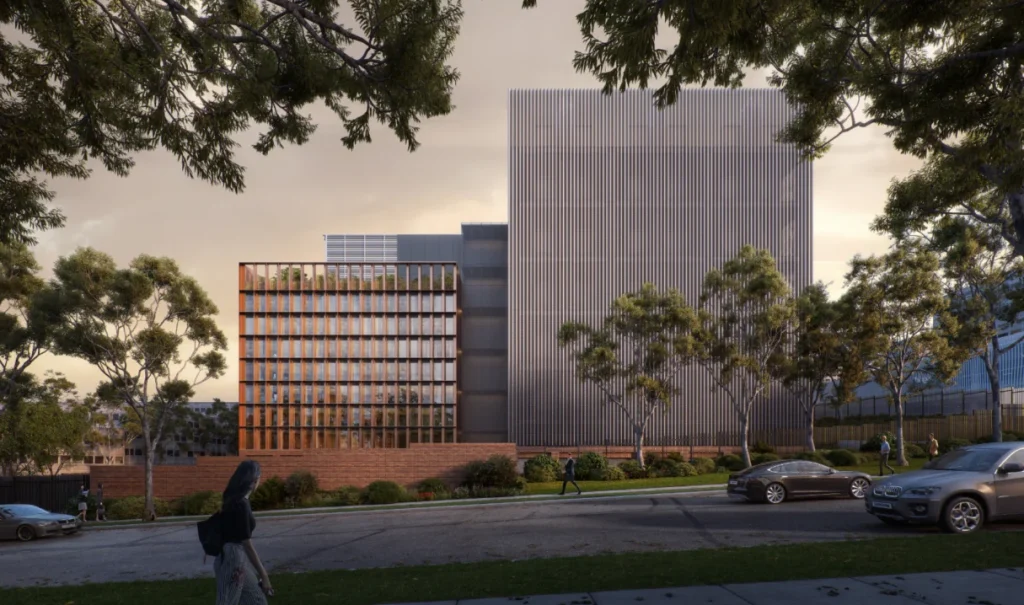
We are experienced in delivering projects on constrained urban sites, where management of logistics and the coordination of multiple concurrent activities are essential. We place particular emphasis on the planning, methods and phasing of the works to ensure smooth delivery and minimise impact on the neighbourhood. This is the same disciplined approach we apply when building adjacent to any live operational facilities.
It is also essential to engage and liaise with local communities and stakeholders in a meaningful way, which needs transparency and clear communication to address any concerns relative to the construction process.
In planning and carrying out the construction phase, our guiding principle is: are we acting as a good neighbour? This means minimising transport movements, dust and noise and any disruption to the communities hosting a data centre.
What sustainability considerations come into play with data centre construction projects?
Sustainability is a key priority for Bouygues Bâtiment International and we are fully committed to decarbonising our activities. This commitment is reflected in two 2030 targets, based on a 2021 baseline: a reduction of 40% of absolute emissions from our worksites and offices for Scope 1 and 2 and a reduction of 30% in intensity for Scope 3, primarily from construction materials and operational energy.
We leverage our in-house engineering expertise to propose design optimisations that reduce material use and increase off-site construction. We prioritise low-carbon and circular materials, such as low-carbon concrete, recycled steel and timber for front-of-house and office areas and use life cycle assessments to identify and recommend low impact solutions to clients.
In close collaboration with clients and their designers, we also optimise energy and water consumption, improving operational efficiency while supporting the long-term economic viability and social acceptance of data centre infrastructure.
In addition to our ISO 14001 (Environmental Management), ISO 9001 (Quality Management) and ISO 45001 (Occupational Health and Safety) certifications, our in-house label, TopSite, whose final approval lies with our clients, recognises projects that exemplify our ESG commitments. More than 80 projects across five continents, including data centres, have been certified.
How can construction partners help data centre developers and operators mitigate obsolescence risk, including the design flexibility built in during the construction phase?
As technology evolves at an unprecedented pace, one of the biggest challenges for data centre developers is ensuring that facilities remain adaptable throughout their lifecycle. The rapid evolution of server technologies, increasing rack densities and changing power and cooling requirements mean that design assumptions can evolve even during the delivery of a project.
Construction partners therefore need to do much more than execute a design. They must actively contribute to building flexibility into the project from the outset. This requires a collaborative approach during pre-construction, the ability to respond quickly to evolving client requirements and robust delivery processes capable of accommodating design changes without compromising programme, quality or safety.
At Bouygues Bâtiment International, we see this as a key differentiator. By working closely with our clients and their technology teams, anticipating future requirements and maintaining agility throughout the construction process, we help clients protect their investment while reducing obsolescence risk and enabling future growth.
What does BBI see as the biggest challenge and the biggest opportunity facing the data centre construction industry over the next five years?
Challenges facing the data centre construction industry are multiple in a booming sector where time-to-market has become a differentiating factor for our clients. Resources and supply chain are key and we are recognised for our capacity to mobilise the right resources internally as well as with our supply chain partners. Industrialisation and off-site construction need to be maximised and are an effective way to minimise tension on the supply chain. It is a factor allowing us to continue serving our clients efficiently with no compromise on quality and safety while meeting budget and timely delivery.

