


As Middle East enterprises accelerate cloud adoption and hybrid work, document-level security is often left behind. Shin Tagawa, Managing Director of Fujifilm Middle East & Africa, explains why CIOs must rethink document infrastructure to maintain trust, compliance and operational resilience.

Six months into your role as Managing Director for the Middle East & Africa, what have been your immediate priorities in strengthening Fujifilm’s relevance to large enterprises and CIOs across the region?
Our priority has been to listen closely to CIOs, IT leaders and our channel partners across the Middle East and Africa. The region is experiencing rapid economic growth alongside increasing regulatory, security and compliance expectations. CIOs are therefore under pressure to modernise infrastructure while maintaining operational resilience and trust.
For Fujifilm, strengthening relevance means moving beyond a product-led conversation to a platform and outcomes based approach. Within our Device Technology division, document workflows remain fundamental to enterprise operations, particularly in government, healthcare, finance and large commercial organisations. Our focus has been on ensuring we help CIOs modernise these workflows securely, efficiently and sustainably.
This includes expanding our Managed Print Services (MPS), accelerating adoption of the Apeos platform and empowering our channel partners to deliver enterprise grade solutions at scale. Independent recognition such as the BLI Pick Awards (Apeos C7070, Apeos C4030, Apeos C325 series, and ApeosPrint C325 dw) provides additional assurance to CIOs that our platforms deliver proven reliability and performance in real world enterprise environments.
As enterprises in the Middle East accelerate Digital Transformation, where do you believe CIOs are underestimating risk or complexity and how is that shaping your regional strategy?
One area that is often underestimated is document level risk. While organisations invest heavily in network and cloud security, documents continue to carry highly sensitive data and move across multiple environments. In hybrid work models, this risk is amplified as information flows between headquarters, remote users and cloud platforms.
This creates exposure not only to cyberthreats but also to compliance and governance challenges. Our regional strategy therefore places document security at the centre of Digital Transformation. Security must be embedded, consistent and independently validated.
Fujifilm products are Common Criteria (CC) certified, a globally recognised security standard used by governments to evaluate IT products. We also comply with HCD-PP standards, developed jointly by the governments of Japan and the United States to protect multifunction printers against cyberthreats, firmware tampering and data leakage. These certifications ensure CIOs are deploying solutions that have been rigorously tested and trusted at a global level.
Fujifilm’s evolution from an imaging company to a business innovation partner mirrors a broader shift in enterprise IT. What does this transformation suggest about how CIOs should rethink infrastructure in a hybrid, security first world, and how does Fujifilm ensure that security protocols remain consistent when document workflows move between a secured head office and a hybrid work environment?
Infrastructure today is no longer defined by physical locations. It spans on-premise systems, cloud platforms, Edge devices and remote users. CIOs must therefore think in terms of policy-driven, consistent infrastructure rather than isolated systems.
Fujifilm’s transformation reflects this reality. With the Apeos platform, we deliver an integrated document infrastructure where hardware, software, security and services work together. Security protocols remain consistent whether documents are processed in a secured head office or accessed in a hybrid environment.
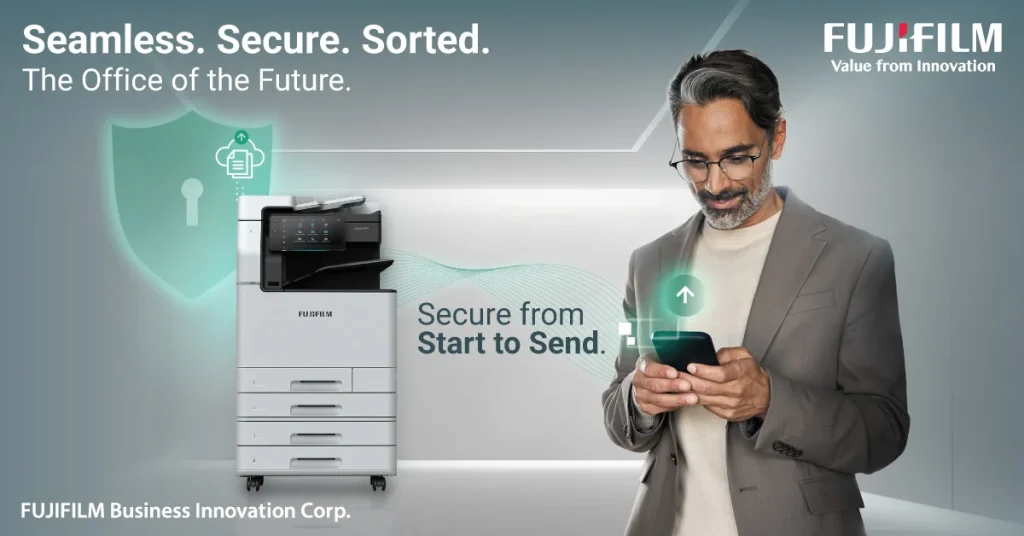
Our devices support FIPS compliant encryption, ensuring data is protected according to US federal standards. We also use a Trusted Platform Module (TPM) chip, which securely stores encryption keys and protects against unauthorised firmware changes. This approach allows CIOs to maintain governance without fragmenting their infrastructure.
Document workflows remain mission critical in regulated environments despite a push to full digitisation. From your perspective, what does a modern document strategy look like for enterprises that must balance agility with security and governance?
A modern document strategy recognises that agility and governance must coexist. Documents are not disappearing, instead, they are becoming part of more intelligent, automated workflows.
From our perspective, modern strategies focus on visibility, control and auditability across the document lifecycle. CIOs need confidence in who accessed a document, how it moved and whether it complied with internal and regulatory requirements.
Fujifilm supports this through secure authentication, role-based access control, automated workflows and comprehensive audit trails. Our solutions align with NIST guidelines, providing CIOs with a trusted cybersecurity framework that balances innovation with risk management. This is particularly relevant in sectors such as government, healthcare and finance, which remain central to regional growth.
Hybrid work has permanently altered how information flows across organisations. How can CIOs regain visibility, control and trust in document workflows without adding operational complexity for IT teams?
CIOs are seeking simplification rather than additional tools. The key lies in intelligent consolidation.
Managed Print Services enable enterprises to centralise visibility, security monitoring and optimisation of their document environments. IT teams gain real time insight into usage, performance and risk, while reducing operational overhead.
Trust is restored when systems are predictable, auditable and resilient. Independent validation, such as BLI Pick Awards, reinforces confidence that performance and reliability are proven, not theoretical.
When designing enterprise document platforms such as the Apeos series, how do you ensure security, resilience and simplicity are embedded by design?
Our design philosophy assumes enterprise complexity and therefore prioritises simplicity at both user and IT levels. Security, resilience and usability are foundational principles.
Security is embedded through CC certification, HCD-PP compliance, FIPS encryption standards, TPM hardware protection and alignment with NIST guidelines. Resilience is supported through robust hardware design, remote diagnostics and proactive service delivery through our channel partners.
At the same time, intuitive interfaces and seamless enterprise integration ensure adoption without compromising control.
Organisations are environmentally conscious and this is increasingly a priority for CIOs. How can technology leaders connect ESG goals with everyday operational decisions?
It’s effective when it is embedded into daily operations. Print and document infrastructure plays a meaningful role in this.
Through energy efficient device design, reduced waste, intelligent fleet optimisation and usage analytics, CIOs can directly influence environmental outcomes. Managed Print Services help organisations right size fleets and track sustainability metrics over time.
This aligns with Fujifilm Group’s global sustainability commitments, including targeting net zero CO₂ emissions by FY2040 and achieving a 50% reduction in CO₂ emissions by FY2030. By aligning operational efficiency with environmental responsibility, CIOs can support ESG goals while maintaining cost discipline.
Looking ahead, how do you see the role of print and document ecosystems evolving in the next five years, particularly in the Middle East where regulatory, security and growth pressures collide?
Print will continue to evolve as part of a broader, secure information ecosystem rather than as a standalone function. Document platforms will become more integrated, intelligent and security-driven.
In the Middle East, regulatory complexity, data protection requirements and rapid enterprise growth will sustain demand for trusted, compliant solutions. CIOs will increasingly seek partners who combine global security standards with strong local execution.
Fujifilm is committed to supporting this evolution through secure platforms, empowered channel partners and long-term investment in innovation, sustainability and trust.
Security by Design, Validated Globally (Security Call-Out Box)
Fujifilm’s enterprise document platforms are built on multiple internationally recognised security standards. Our products are Common Criteria (CC) certified and comply with HCD-PP[AI1] , a stringent security profile developed by the governments of Japan and the United States to protect multifunction printers from cyberthreats and unauthorised firmware changes.
We also support FIPS compliant encryption, use dedicated TPM hardware to safeguard encryption keys and align with NIST cybersecurity guidelines. Together, these layers ensure our devices are secure by design, tested for resilience and trusted globally.

