


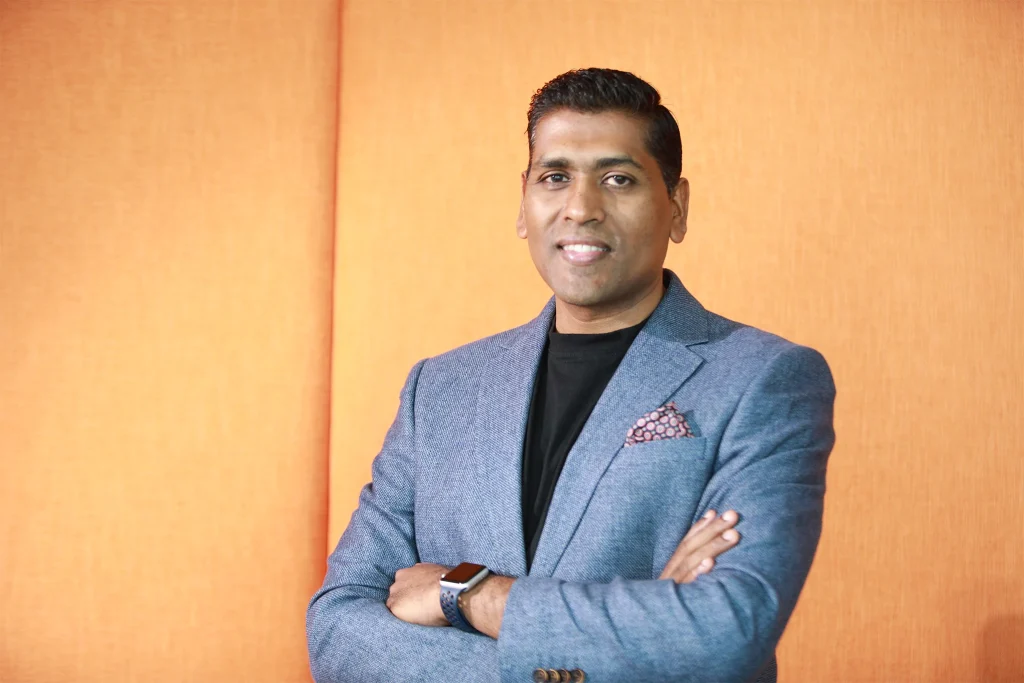
As AI reshapes enterprise technology, Oracle sees the mid-market as its next major growth engine. Cherian Varghese, Senior Vice President, Mid Market, EMEA at Oracle, explains how AI, cloud and a partner-first strategy are helping organisations accelerate innovation without enterprise-scale complexity.
How do you define the mid-market, and why do you see it as a significant growth opportunity for Oracle?
Oracle segments the market quite carefully. At the top, we have what we call major accounts or strategic accounts. These are typically a select group of around 10 to 15 organisations in each country, where we pursue large, multi-million-dollar opportunities with dedicated sales and technical teams.
Below that are our enterprise accounts, and then comes the mid-market. Interestingly, the definition of enterprise varies from country to country, so we tailor our segmentation accordingly. Taking the UAE as an example, we consider the top 1,000 organisations as enterprise customers. Everything below that falls into the mid-market. Given that there are more than 25,000 businesses in this segment, it represents a substantial opportunity for Oracle. NetSuite forms an important part of that mid-market strategy.
Within the mid-market, we have several routes to market. First, there is our core infrastructure and technology business. Alongside that, we offer Oracle Fusion Applications for organisations looking for enterprise-grade ERP and HCM capabilities. NetSuite addresses businesses that want to implement ERP or HCM on a smaller scale while still benefiting from a modern cloud platform.
Another important segment is hospitality and retail. While it may begin with a point-of-sale solution, that creates a valuable entry point into the broader Oracle portfolio. Whether it’s a neighbourhood grocery store, a large international hotel chain, an independent hotel or a restaurant, every point-of-sale system generates valuable business data. That data requires storage, analytics and cloud infrastructure, creating opportunities for Oracle Cloud Infrastructure (OCI), NetSuite and, ultimately, Oracle Fusion Applications.
The Middle East is also a thriving ecosystem for start-ups and scale-ups. Companies that have secured their initial funding and are beginning to grow represent an excellent fit for Oracle’s technology portfolio.
Our definition of the mid-market is therefore not simply based on company size. Across EMEA, which spans around 109 countries, Oracle has identified approximately 70 markets where the mid-market represents a significant growth opportunity.
The requirements of mid-market organisations are very different from those of large enterprises. Are Oracle’s offerings specifically tailored for the mid-market, or do you simply scale down your enterprise products?
It really depends on which product portfolio we’re talking about.
Take NetSuite, for example. NetSuite is designed specifically for the mid-market. It isn’t simply Oracle Fusion scaled down for smaller organisations. The product has been built with the needs of mid-sized businesses in mind.
That said, the mid-market is not a single, homogeneous segment. While many customers are price-sensitive, not all of them are. Some organisations simply want the most robust platform available because they have ambitious growth plans.
Imagine a start-up that already knows its next funding round is coming. Perhaps it expects significant venture capital investment and has a clear roadmap to becoming a US$100 million business. In that case, it may choose Oracle Fusion from the outset rather than starting with NetSuite and migrating later. The decision is driven by business strategy rather than company size.
The same principle applies to our database portfolio. We offer both Standard Edition and Enterprise Edition. Some mid-market customers find Standard Edition perfectly adequate, while others anticipate rapid growth in transactions and users, making Enterprise Edition the better long-term choice.
I think the days of assuming that enterprise technology is only for large enterprises are over.
Take Oracle Cloud Infrastructure (OCI) as another example. A mid-market customer beginning its innovation journey uses the same OCI platform as one of our largest global customers. The technology is identical. The only difference may be the commercial model or contractual arrangement.
This is one of Oracle’s key differentiators. Whether the customer is Uber or a small business in Malawi, the service levels remain the same. Once you’re a cloud customer, you’re a cloud customer. There is no difference in the underlying platform or service-level agreement.
The beauty of cloud is that every customer benefits from the same continuous innovation. Everyone receives the latest software updates, security patches and feature enhancements. In the on-premises world, every upgrade required a services partner, a new project, procurement processes and significant cost. Today, those barriers have disappeared. Every customer, regardless of size, stays on the latest release with the latest security protections.
As a result, the gap between enterprise and mid-market technology is becoming much narrower.
Many mid-market customers want to adopt AI but are unsure where to begin because they typically don’t have large in-house IT or AI teams. How is Oracle helping customers operationalise AI, particularly given that AI is embedded across your applications?
Let me start with our applications portfolio. When Oracle Fusion was launched, our products were already AI and agent-ready. We had AI agents built into the applications, but many customers simply weren’t using them. For various reasons, they remained at the pilot stage or customers experimented with them without moving into production.
A few years ago, we started embedding AI agents across Oracle Fusion ERP, HCM and our broader applications portfolio. Today, we have well over a thousand AI agents available across Fusion. Even within NetSuite, agentic AI capabilities are now available without customers needing to make additional investments.
However, we realised that providing the technology alone wasn’t enough. Customers needed guidance on how to adopt it.
That’s why Oracle created what we call our Lift Team. Through our Lift services, which we currently provide as an investment to our customers, we work closely with organisations that want to adopt AI but aren’t sure where to begin.
A customer may come to us and say, “Our board wants us to use AI across the business. How do we get started?” We sit down with them, whiteboard the use cases, identify where AI can deliver business value and help them build a practical adoption roadmap.
The results have been very encouraging. At our recent sales kick-off, we found that around 66% of customers who have purchased Oracle Fusion over the past two years have already begun adopting AI in some form. That didn’t happen simply because the technology was available. It happened because we helped customers translate AI into real business outcomes rather than letting it become shelfware.
The same approach applies to our technology portfolio. We begin with small, practical use cases using capabilities such as AI Vision and AI Speech, allowing customers to experience tangible business value before scaling further.
From there, the strategy depends on the customer’s objectives. If they’re focused on simple inference use cases, we follow one approach. If they’re looking at large-scale AI model training, that’s a different conversation altogether, requiring a different architecture and deployment strategy
What role do partners play in your mid-market GTM strategy?
We’re trying to make Oracle’s mid-market business 100% partner-focused. It’s a challenging transition, but I think the timing is right.
You have to understand where Oracle is coming from. We weren’t born as a cloud company. Our heritage is in enterprise software and on-premises infrastructure. As we transitioned to the cloud, particularly with Oracle Cloud Infrastructure, the first few years were about proving ourselves in the market.
When I talk about OCI, we’re really only three or four years into that journey. During those early years, we had to convince customers that OCI was a compelling cloud platform. Other hyperscalers had entered the market much earlier and had established strong positions, so Oracle had to invest significant effort in building credibility and demonstrating the strength of our technology.
Today, the situation is very different. We’ve laid a solid foundation over the past few years, and OCI has established itself as a leading hyperscaler. More importantly, our partner ecosystem has matured alongside us.
That’s why, starting this financial year in June, we’ve made a strategic decision to go all in with our partners.
When I say “partner first”, I genuinely mean it. Across EMEA, we have around 1,000 people focused on the mid-market. My expectation is that every one of them works alongside our partners, engaging customers together, building opportunities together and creating a true multiplier effect.
For us, this represents one of the biggest strategic shifts in the mid-market. It’s not simply about saying we are partner-led, because many organisations make that claim. The real challenge is execution.
This time, we want to ensure we genuinely walk the journey with our partners, helping them build capabilities, win business and create meaningful differentiation in the market. That’s what will define the success of our partner-first strategy.

