


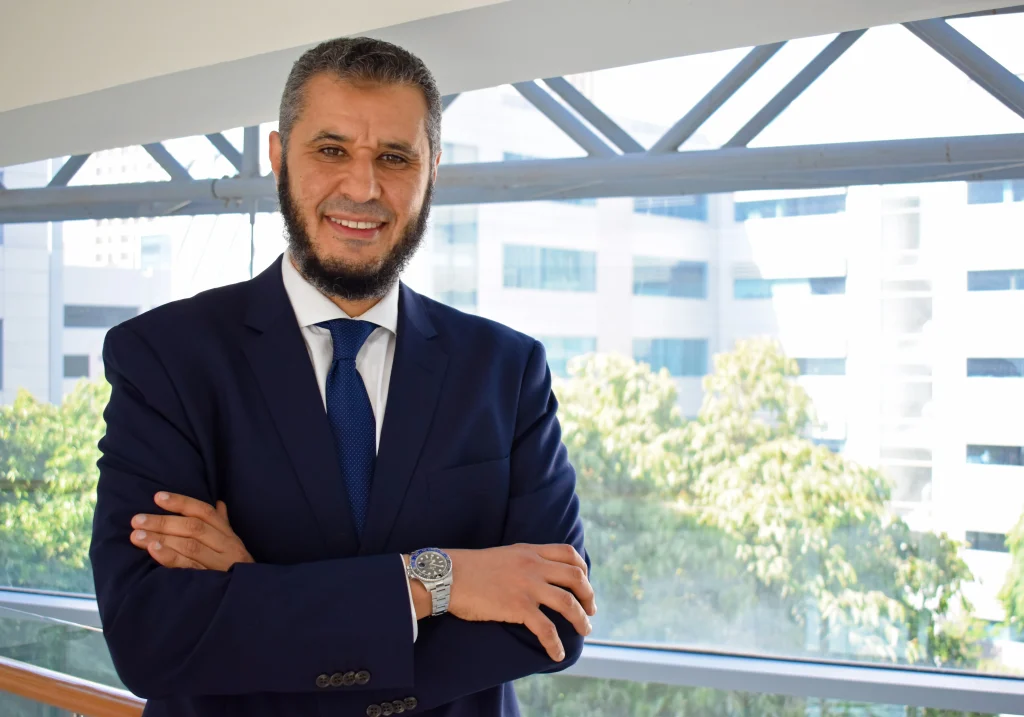
In this thought leadership piece, Ashraf Hassan, General Manager, Infrastructure Solutions Group (Gulf) at Lenovo, argues that the region’s AI aspirations and sustainability commitments are not competing priorities. Instead, achieving both depends on making smarter decisions about how AI infrastructure is designed, deployed and managed.
The Middle East is amid an extraordinary transformation, driven by ambitious national roadmaps like Saudi Vision 2030 and the UAE’s Artificial Intelligence Strategy 2031. In today’s age, artificial intelligence is no longer a niche technology but has evolved into the engine of a new economy. Enterprises across the region are embedding AI into their core operations at a breathtaking pace, and the confidence in this strategy is clear.
According to IDC research from the Lenovo CIO Playbook 2026, an overwhelming 91% of Middle Eastern organisations plan to increase their AI budgets, anticipating a remarkable return of $2.74 for every dollar invested.
This wave of innovation promises to unlock unprecedented efficiency, create new revenue streams, and enhance public services. However, it also presents a critical paradox: the immense computational power required to train and run these advanced AI models carries a significant environmental cost. As data centers expand to meet demand, energy consumption and carbon footprints are becoming urgent concerns. This raises a crucial question: how can the region build its AI-powered future without it costing the earth?
The answer is not to slow down innovation, but to pursue it more intelligently. AI itself can be a powerful force for sustainability. It can optimise energy grids, create more resilient supply chains, and power the next wave of green manufacturing. The true challenge lies in ensuring that the infrastructure powering this AI is as sustainable as the solutions it creates.
This is where a strategic shift in IT infrastructure becomes essential. Recognizing this, enterprises in the Middle East are already showing a strong preference for control and efficiency in their deployments. The CIO Playbook 2026 reveals that 62% of organisations in the region favour hybrid AI models, leveraging a mix of on-premises and cloud infrastructure to maintain data sovereignty and manage performance. This approach is a step in the right direction, but it must be paired with hardware that is fundamentally designed for sustainability.
Infrastructure choices have never mattered more. The next generation of data centres cannot be cooled by air alone. Liquid cooling technology uses the superior thermal conductivity of liquid to cool components far more effectively that conventional methods, reducing energy consumption significantly and allowing organisations to run powerful AI workloads while lowering both their environmental impact and operational costs. For a region where ambient temperatures already place enormous strain on cooling systems, this is not an incremental improvement. It is a foundational shift.
The Middle East has a genuine opportunity to leapfrog legacy technologies and set a global benchmark for sustainable AI. The region’s commitment to innovation, backed by significant investment, creates the perfect environment to build a digital ecosystem that is both powerful and responsible.
By making strategic choices in infrastructure, partnering with technology leaders who prioritize sustainability, and embracing a vision of “smarter AI for all,” the region’s enterprises can confidently answer the question. Yes, we can build the future without costing the Earth. We can create a thriving, AI-driven economy that is not only innovative and resilient but also sustainable for generations to come.

