

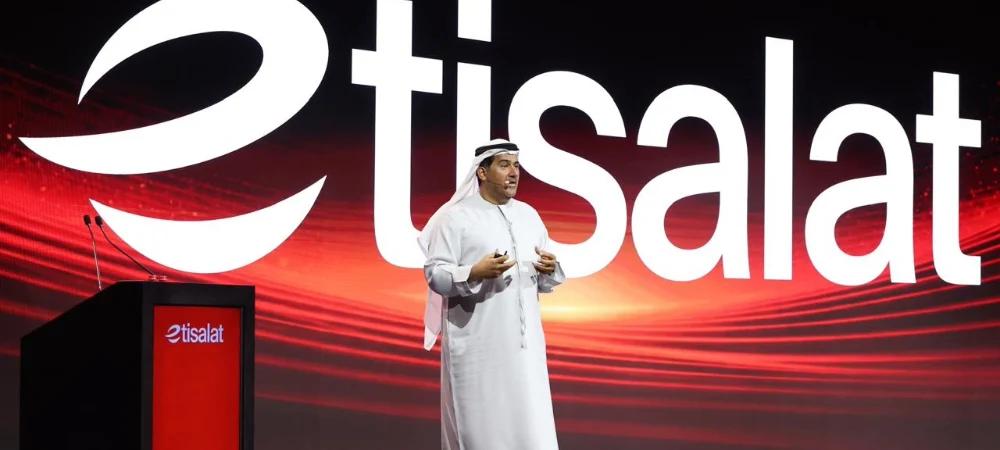
At a customer event in Dubai, etisalat outlined an ambitious strategy to evolve from a connectivity provider into a trusted partner for sovereign intelligence. By bringing together AI infrastructure, secure connectivity, edge computing, industry-specific applications and an expanding technology ecosystem, the company aims to help governments and enterprises deploy AI securely, at scale, while retaining control over their critical systems and data.
Artificial intelligence is entering a new phase in which its value will increasingly be measured not by the sophistication of individual models, but by how effectively those models can operate across businesses, public services and critical infrastructure.
For governments and enterprises, this transition presents a complex challenge. AI requires computing power, high-performance networks, secure data environments, governance frameworks and applications designed for specific operational requirements. Bringing these elements together can be costly and complicated, particularly when sovereignty, security and business continuity are non-negotiable.
The strategy represents a significant evolution in the company’s role. Rather than positioning itself solely as a provider of connectivity and infrastructure, etisalat is seeking to become an enabler of AI adoption, combining its established telecommunications capabilities with sovereign computing, distributed intelligence and industry-specific solutions.
At the centre of this approach is etisalat AIO, an architecture comprising ten technology stacks organised around three pillars: intelligence foundations, vertical solutions and business solutions. Together, they are designed to connect the infrastructure that powers AI with the applications that deliver measurable operational value.
The underlying proposition is that governments and enterprises should be able to access AI capabilities without having to independently assemble every component of the technology stack.
For etisalat, this is also about preparing for a future in which AI moves beyond software applications and becomes embedded in industrial equipment, autonomous vehicles, drones, robotics and mission-critical infrastructure.
From connectivity to sovereign intelligence
etisalat’s transformation is built on the premise that telecommunications operators are uniquely positioned to support the next generation of AI applications. Their networks already connect millions of customers, enterprises and public institutions, while their infrastructure provides the foundation for moving data between centralised computing environments and distributed devices.
The company’s strategy reflects three stages in this evolution. Between 1976 and 2021, its primary role was connecting people and businesses. From 2022 to 2026, the wider e& group expanded into areas including cloud, cybersecurity, fintech and digital services. Its next phase, extending towards 2030 and beyond, places AI at the centre of its operating model and customer proposition.
The ambition is to become the world’s leading AI-powered and AI-enabling telecommunications group, with four principal business lines: Telco, Infra, AI & Business Solutions, and Fintech.
The scale of its existing operations provides a substantial foundation for this strategy. According to its third-quarter 2026 financial results, the group reported 254.8 million subscribers and consolidated revenue of AED 57.6 billion for the first nine months of the year, an increase of 10% year on year.
This customer base is particularly important as etisalat looks to make AI capabilities available through existing connectivity and enterprise service packages.
During the event, the company outlined an ambition to integrate AI agents and tokens into its service offerings, effectively making access to AI computing resources part of the telecommunications experience.
The proposition is straightforward: customers should not need to independently procure GPUs, identify data centre capacity, select models and integrate multiple infrastructure providers before they can begin deploying AI.
Instead, etisalat wants to bring these capabilities together through its own infrastructure and an expanding partner ecosystem.
Its stated ambition is to offer customers a simplified model built around one factory, one bundle and one bill.
Building the foundations for sovereign AI
The first pillar of etisalat AIO focuses on the infrastructure required to power, connect and distribute AI.
This includes AI Data Centres, AI Connect and the AI Compute & Token Factory.
AI data centres form the foundation of the architecture, providing the specialised computing, storage, cooling and power infrastructure needed to train and operate AI models at scale.
A central consideration is sovereignty. Etisalat’s approach includes localised hosting environments designed to meet national data residency, security and regulatory requirements.
The company is also developing modular and portable data centre infrastructure that can be deployed closer to customer operations. These systems are designed with pre-integrated components, optimised power and interconnects, and the ability to operate in challenging environments.
For governments and enterprises, such deployment flexibility is important where AI workloads must remain within specific jurisdictions or operate at remote industrial locations.
The second component, AI Connect, addresses the networking requirements of distributed AI.
As AI workloads move between data centres, enterprise sites and connected devices, networks must deliver predictable performance, low latency and high reliability.
etisalat’s architecture incorporates capabilities such as dynamic network slicing, workload-aware bandwidth allocation and predictive, self-healing routing.
These capabilities are particularly relevant to applications where delays or interruptions could have operational consequences, including emergency response, industrial monitoring and autonomous systems.
The third component is the AI Compute & Token Factory, which brings together GPU-accelerated computing, managed infrastructure, orchestration and flexible deployment models.
The portfolio includes GPU-as-a-Service, private deployments, air-gapped environments and ruggedised GPU infrastructure.
Together, these capabilities are intended to give enterprises access to AI computing resources without requiring them to build and manage every element of the underlying infrastructure.
For organisations handling sensitive information, private and isolated deployments also provide options for retaining greater control over AI workloads.
Sovereignty must extend beyond data residency
One of the strongest messages emerging from etisalat’s AI strategy is that sovereignty cannot be reduced to the physical location of data.
During the event, the company emphasised that genuine technological sovereignty must encompass design, deployment and operations.
A platform may be hosted within a country’s borders, but if it remains dependent on external providers for software updates, operational management or essential services, its independence may still be limited.
The distinction becomes particularly important as governments and enterprises deploy AI across critical national infrastructure.
Sovereignty, in this context, is about maintaining operational control and ensuring that essential services can continue functioning even when external dependencies are disrupted.
Data residency remains an important requirement, but it represents only one part of the broader sovereignty framework.
etisalat’s approach is therefore to incorporate sovereignty into the architecture from the outset, rather than treating it as a compliance requirement addressed after deployment.
This includes private computing environments, localised data processing, secure infrastructure and governance mechanisms designed around the requirements of individual markets.
The company is also seeking to leverage its regional infrastructure to support business continuity and resilience across the countries in which it operates, subject to local regulatory requirements.
Bringing intelligence closer to where decisions are made
While data centres provide the computing capacity needed for large-scale AI, many emerging applications require intelligence to operate much closer to the physical environment.
This is driving etisalat’s investment in edge AI.
Rather than transmitting every data stream to a centralised cloud platform for processing, edge AI enables inference to take place locally, using computing resources embedded within cameras, gateways, sensors or nearby infrastructure.
The advantages include faster response times, reduced data transmission and greater operational resilience in locations where connectivity may be limited.
etisalat highlighted its work with ADNOC and AIQ as an example of this approach.
At an oil exploration location where conventional coverage was unavailable, the company described using GPUs and computer vision to support health and safety monitoring through local AI inference.
The deployment illustrates how AI can support industrial operations without requiring continuous reliance on distant computing infrastructure.
Similar applications are emerging across ports, logistics facilities and other industrial environments.
Cameras can increasingly move beyond conventional surveillance to become intelligent systems capable of identifying safety hazards, detecting anomalies and supporting operational decisions.
etisalat also outlined plans to deploy GPU computing capabilities at distributed network and industrial sites.
Its broader architecture envisages AI inference taking place at three levels: directly at the operational site, at the network edge and within centralised data centres.
This flexibility is essential because different industries have different performance, security and regulatory requirements.
An autonomous industrial system may require immediate local processing, while an enterprise analytics application may be better suited to a centralised environment.
The company’s strategy is to provide the infrastructure and orchestration needed to support both.
Securing mission-critical operations
Security is another central component of etisalat AIO.
The company’s AI Security & Quantum portfolio combines AI-driven threat detection and response with preparations for post-quantum cryptography.
The immediate priority is strengthening cyber resilience through behavioural anomaly detection, threat intelligence and automated security orchestration.
At the same time, etisalat is addressing the longer-term implications of quantum computing for existing encryption technologies.
Its approach includes post-quantum cryptography roadmaps and quantum-resistant key exchange mechanisms intended to help organisations prepare for future cryptographic threats.
These capabilities sit alongside the company’s AI Mission Critical portfolio, which is designed for environments where operational continuity and public safety are paramount.
Potential applications include emergency response, utilities, transport infrastructure and municipal services.
For example, AI could identify unusual operating conditions at an electricity substation before they develop into a wider outage.
In emergency services, it could support situational awareness, identify available resources and help coordinate responses across multiple agencies.
Importantly, the architecture retains human oversight for critical decisions.
This distinction becomes increasingly significant as AI systems gain greater autonomy.
For governments and operators of critical infrastructure, the objective is not simply to automate decisions, but to improve the speed and quality of operational responses while maintaining accountability.
The combination of secure communications, localised intelligence, predictive analytics and sovereign controls is intended to strengthen resilience across essential services.
Developing industry-specific AI solutions
etisalat is also moving beyond general-purpose AI infrastructure towards solutions designed for individual sectors.
Its AI Industrial Solutions portfolio combines computer vision, predictive analytics and digital twins to help organisations monitor assets, identify emerging risks and improve operational performance.
One example highlighted in its portfolio is Smart Wadi, an application designed to monitor water levels and provide early flood warnings.
Other potential applications include detecting safety hazards at industrial sites, identifying equipment defects and using digital twins to simulate operational changes before implementing them.
The company recognises that a single technology stack cannot address the requirements of every industry.
Financial services organisations, for example, face different regulatory, security and operational demands from energy companies, healthcare providers or government agencies.
etisalat’s approach is therefore to develop sector-specific architectures that combine the appropriate infrastructure, AI models, connectivity and security controls.
This is also where its partner ecosystem becomes important.
Rather than attempting to develop every component independently, the company is working with technology providers, sovereign cloud platforms, AI specialists and infrastructure partners to assemble solutions suited to customer requirements.
During the event, it highlighted the strength of the UAE’s expanding AI ecosystem, including organisations such as G42, Core42, Moro Hub and AIQ.
The message was that the scale of the AI opportunity requires collaboration across the industry, with telecommunications operators providing an important infrastructure and service delivery foundation.
Preparing for the era of physical AI
etisalat expects the next stage of AI adoption to extend beyond enterprise software into physical environments.
The company identified 2027 as a potentially significant year for physical AI, with autonomous mobility, drones and robotics moving towards broader deployment.
By 2028, it anticipates growing adoption of AI in mission-critical sectors such as energy, oil and gas, civil defence and transport.
These timelines reflect the company’s strategic outlook rather than established industry-wide forecasts.
Its physical AI portfolio includes agentic AI, drones and robotics.
Agentic AI enables software-based systems to perform tasks across multiple enterprise applications, rather than simply generating responses to user queries.
Such agents can coordinate workflows, access business systems and execute actions within defined governance and approval boundaries.
etisalat sees opportunities to deploy these capabilities across customer service, procurement, logistics and other business processes.
Its own operational initiatives provide examples of the potential impact.
According to the company’s media fact sheet, AI-powered enterprise workflows are resolving 70% of customer enquiries, while agentic capabilities are helping double lead generation and process up to 80% of orders.
In procurement, agentic AI has reduced workflow times by approximately 70%, with AI recommendations achieving accuracy levels above 80%.
The company also reports that AI-enabled software development has reduced product launch times by up to 80% for simple products and 40% for more complex offerings.
Meanwhile, AI-powered voice agents have achieved a Net Promoter Score of +78 and increased conversion rates by 30% upon launch.
These results illustrate how etisalat is seeking to apply AI internally before extending similar capabilities to enterprise customers.
Beyond software agents, the company is exploring network-connected drones equipped with AI-driven computer vision and edge analytics.
Potential applications include infrastructure inspections, perimeter monitoring, emergency surveys and precision logistics.
Its robotics portfolio focuses on autonomous mobile robots, collaborative robots and centralised fleet orchestration.
These technologies could support warehouse operations, healthcare facilities, industrial environments and enterprise services.
For telecommunications operators, physical AI also creates new requirements for secure, low-latency connectivity.
Autonomous machines need reliable communications, local intelligence and the ability to exchange information with wider operational systems.
etisalat believes its existing network infrastructure, combined with edge computing and AI orchestration, can provide a foundation for these emerging applications.
Making AI accessible through a unified ecosystem
Perhaps the most commercially significant element of etisalat’s strategy is its ambition to simplify AI consumption.
For many organisations, adopting AI currently involves navigating a fragmented ecosystem of infrastructure providers, cloud platforms, model developers, cybersecurity vendors and systems integrators.
etisalat wants to reduce this complexity by bringing these capabilities together through integrated service packages.
The company outlined plans to incorporate AI agents and tokens into connectivity and enterprise offerings, enabling customers to consume AI capabilities through a familiar service model.
It also described an ambition to develop an agentic AI factory and establish AI centres of excellence across three countries.
These initiatives are intended to support the development, deployment and scaling of AI solutions for different industries and markets.
The scale of the potential demand is substantial.
During the event, etisalat presented an illustrative calculation suggesting that supporting its customer base with AI agents could require more than 600 megawatts of computing capacity by 2030.
The estimate was based on assumptions about AI agent adoption among small and medium-sized businesses and highlights the infrastructure requirements that could emerge as AI becomes a mainstream enterprise service.
For etisalat, its existing customer relationships provide an advantage.
Rather than building computing infrastructure solely for an uncertain future market, the company is seeking to align its investments with the requirements of customers it already serves.
This approach could also create opportunities for smaller businesses that lack the resources to develop and operate sophisticated AI environments independently.
By integrating computing, models, connectivity and security into managed offerings, etisalat aims to lower the barriers to enterprise AI adoption.
A new role for telecommunications in the AI economy
etisalat’s AI strategy reflects a broader shift in the telecommunications industry.
For years, operators have faced pressure to diversify beyond traditional connectivity services as more value moved towards cloud platforms, applications and digital ecosystems.
AI is changing that equation.
The growth of distributed intelligence, autonomous systems and data-intensive applications is increasing the strategic importance of the infrastructure that telecommunications operators already own and operate.
Networks, data centres, edge computing facilities and secure communications platforms are becoming essential components of the AI economy.
etisalat is seeking to capitalise on this shift by positioning itself as both an AI-powered organisation and an AI-enabling technology provider.
Its strategy is not without challenges. Building sovereign AI infrastructure at scale requires substantial capital investment, specialised expertise, reliable power capacity and coordination across a complex partner ecosystem.
Governments and enterprises will also expect demonstrable assurances around security, operational independence, regulatory compliance and the reliability of AI-driven systems.
The success of the approach will ultimately depend on how effectively etisalat can integrate these capabilities into commercially viable services that deliver measurable outcomes.
Nevertheless, the direction is clear.
By combining sovereign infrastructure, secure connectivity, distributed computing, industry-specific applications and a growing AI partner ecosystem, etisalat is attempting to redefine the role of telecommunications in the age of autonomous intelligence.
Its ambition extends beyond providing the networks on which AI applications operate.
It wants to deliver the foundations that allow governments and enterprises to deploy AI with greater control, resilience and confidence.
As AI moves from experimentation into essential business processes and critical national infrastructure, that combination of sovereignty, security and scalability could become one of the defining requirements of the next phase of Digital Transformation.

