

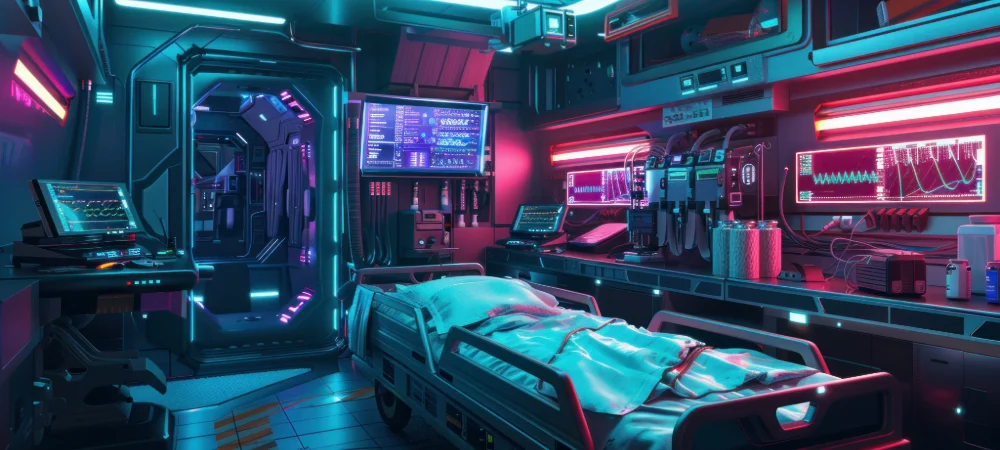
NASA’s Johnson Space Center has worked with Red Hat to build the Crew Medical Officer Digital Assistant (CMO-DA) – a clinical decision support tool designed to help astronauts diagnose and treat symptoms without requiring a connection to Earth.
Most modern AI depends on a connection to the cloud. However, future missions to the Moon and Mars will require astronauts to operate without continuous communication with Earth. CMO-DA addresses this challenge by running entirely offline using RamaLama, a Red Hat-backed open source project that packages AI models as containers so they run predictably and securely, even on edge hardware in space.
Key capabilities include:
• Fully offline system: CMO-DA has moved from a cloud-dependent prototype to edge deployment, ensuring mission success even when the link to Earth is severed.
• Multimodal AI: RamaLama runs both large language models for medical reasoning and vision models for image-based symptoms.
• Auditable and reproducible: This is critical for emergency situations, particularly when human lives hang in the balance. If it works in space, the same edge AI blueprint could also bring offline medical guidance to remote and underserved communities on Earth.
Researchers at NASA’s Johnson Space Center in Houston are testing the Crew Medical Officer Digital Assistant to support future deep space missions where real-time communication with Earth-based medical teams may be limited or impossible.
Powered by RamaLama for local AI inference, the clinical decision support system has been designed to help astronauts diagnose and treat medical symptoms while ensuring mission success even when communication with Earth is unavailable.
What is RamaLama?
RamaLama is a Red Hat-backed open source tool designed to ‘make AI boring’ by simplifying how developers run, pull and serve AI models.
Led by Red Hat engineers, the project treats AI models like container images, allowing them to run in isolated, security-first environments across diverse hardware, from laptops to specialised edge servers in space.
By using Open Container Initiative (OCI)-compliant containers, RamaLama enables AI models to be portable and predictable, which is essential when deploying technology into the extreme conditions of spaceflight.
From proof of concept to autonomous edge reality
The CMO-DA began as a proof of concept to demonstrate how AI trained on spaceflight medical literature could provide real-time health analyses. However, to become mission-ready, the project had to move from a cloud-dependent model to a fully disconnected edge deployment. In deep space, relying on a terrestrial cloud connection is not an option.
This transition to autonomous operation is currently powered by RamaLama running on HPE hardware, specifically the terrestrial twin of the Spaceborne Computer currently aboard the International Space Station.
• Multimodal inference: RamaLama provides the engine to run both large language models (LLMs) for complex medical reasoning and Vision Language Models (VLMs) for image-based symptom analysis. This allows the CMO-DA to process both text and visual data without requiring a massive infrastructure footprint.
• The edge advantage: By utilising RamaLama, researchers can run sophisticated AI models locally on the device, making medical guidance available instantly regardless of the spacecraft’s distance from Earth.
By using these open source tools, NASA researchers can test a system that is reproducible and auditable, essential factors for human safety in mission-critical environments.
What’s next for CMO-DA?
The current terrestrial testing on the Spaceborne twin allows the team to refine the system before the final push to the International Space Station. Once validated on Earth, the CMO-DA will be demonstrated to NASA leadership so the agency can evaluate its future use.
Looking ahead, the project team plans to integrate Red Hat Enterprise Linux AI (RHEL AI) for the next iteration of the CMO-DA. The move to RHEL AI will provide a stable, hardened foundation and a more seamless way to scale and manage these containerised AI applications in some of the world’s harshest remote environments.
This milestone is not only a leap forward for space medicine but also a potential blueprint for the future of AI at the edge. The same technologies helping astronauts stay healthy in deep space could one day provide high-quality medical care in some of the most remote locations on Earth.

