

From forecasting millions of product and customer combinations to deploying digital twins across factories, Unilever is building an interconnected, AI-powered supply chain designed to respond faster to changing consumer demand, global disruption and major retail events.
For a consumer goods business operating at Unilever’s scale, supply chain management is no longer simply about moving products efficiently from factories to retailers. It is increasingly becoming a technology-led operation in which AI, digital twins, real-time data and human expertise combine to predict demand, manage disruption and unlock growth.
Every day, Unilever moves products from hundreds of factories through complex global networks to reach billions of consumers. The challenge is ensuring those products are available where and when they are wanted, while responding to demand patterns that can change almost instantly.
According to Vicky Cuthbert, Chief Product Supply Chain Officer for Personal Care at Unilever, that shift has fundamentally changed the speed at which supply chains need to operate.
Demand cycles for consumer brands, she says, have shortened from months to hours. Unilever has responded by investing in people, AI and digital technologies, while reducing concept-to-pilot timelines to 12 weeks and developing more predictive customer operations.
The goal is to create a supply chain capable of anticipating change rather than simply reacting to it.
From consumer signal to factory floor
One example of this approach was the Dove x Crumbl collaboration at Walmart. Social listening helped identify consumer interest, while production, replenishment and product variant releases were adjusted using live feedback and demand signals.
The collaboration illustrates the increasingly connected nature of retail, marketing and supply chain operations. Consumer behaviour can now influence decisions stretching all the way back to manufacturing and material sourcing.
Unilever is extending this principle through its AI-enabled customer connectivity model with Walmart, which integrates forecasting and sales data and connects consumer purchases back to sourcing decisions.
During a pilot in Mexico, the model delivered more than 98% on-shelf availability while reducing inventory and supporting category growth.
The company is also developing direct-to-consumer capabilities. The factory-to-consumer model has accelerated fulfilment by 75% while reducing logistics costs by almost a quarter, demonstrating how digitalisation can change not only manufacturing but also the route products take to consumers.
Resilience becomes a digital challenge
Supply chain resilience has assumed greater importance as manufacturers contend with energy price volatility, extreme weather, geopolitical uncertainty and disruption to global shipping routes.
For Unilever, resilience means being able to anticipate disruption, understand its potential impact and respond quickly.
The company has spent years strengthening its operations through measures including renewable energy adoption and the Digital Transformation of its Supply Chain. Increasingly, however, AI and data are providing another layer of resilience.
AI is being used to improve demand and supply forecasting, while digital twins simulate manufacturing processes to improve production performance and reduce energy consumption. Other digital tools provide greater visibility across logistics operations.
Together, these technologies are creating what Cuthbert describes as a technology ecosystem capable of identifying potential disruption earlier, assessing alternative scenarios and helping teams make faster decisions.
Rather than relying on isolated digital applications, the ambition is to connect information across the supply chain so that a change in one part of the operation can inform decisions elsewhere.
World Cup puts supply chain to the test
Few events illustrate the scale of that challenge better than the FIFA World Cup 2026.
Unilever activated 35 brands and 180 limited-edition products across more than 120 countries and millions of retail locations as part of its sponsorship.
Behind the marketing campaign sat a substantial supply chain operation involving sourcing, manufacturing, logistics and retail execution.
Planning began by determining which products individual brands would promote and ensuring sufficient raw materials, manufacturing capability and logistics capacity were available.
Once production plans were established, attention shifted towards ensuring products reached retailers at the right moment. Those destinations ranged from major international retailers to hundreds of thousands of smaller independent stores.
At the same time, marketing campaigns ran across social media, television, outdoor advertising and physical stores, supported by more than 50,000 creators globally.
That created the potential for sudden demand spikes, meaning even detailed forecasting needed to be accompanied by operational flexibility.
The response following the tournament final demonstrated the speed required. Within days of Spain winning the competition, special limited-edition ‘World Champions’ Rexona deodorants were ready for dispatch.
Such responsiveness depends on connecting marketing activity, consumer demand signals and manufacturing capacity much more closely than would have been possible using traditional supply chain processes.
AI forecasting at massive scale
At the centre of Unilever’s technology strategy is the ability to make sense of huge quantities of operational data.
Its Forecast Engine Utility combines machine learning and data science to generate a 104-week forecast every week across more than five million product-customer combinations in 40 operating markets.
That scale would be extremely difficult to manage through conventional forecasting methods.
“AI in supply chain helps us make better decisions at scale, but human expertise remains key,” Cuthbert says. “Our people provide the judgement, context and experience needed to make the final decisions.”
This human-plus-AI model is central to Unilever’s approach. AI processes information, identifies patterns and supports scenario planning, but responsibility for interpreting those insights remains with employees.
The technology is also moving deeper into manufacturing.
Unilever’s Raeford factory in North Carolina, which played an important role in producing products for the FIFA World Cup 2026, provides another example.
The facility uses digital twins to model manufacturing processes, contributing to improved product quality, a 20% reduction in waste and a 10% increase in capacity.
Digital twins effectively provide manufacturers with virtual versions of physical processes. Engineers can examine performance, test potential changes and identify problems without disrupting the real production environment.
Building the connected supply chain
The next stage of Unilever’s strategy is to move beyond individual AI applications towards an interconnected digital environment.
A five-year partnership with Google Cloud is intended to establish an enterprise-wide digital backbone capable of turning data into actionable insights and supporting agentic workflows across business processes.
Manufacturing is expected to become increasingly predictive and scenario based as part of that transition.
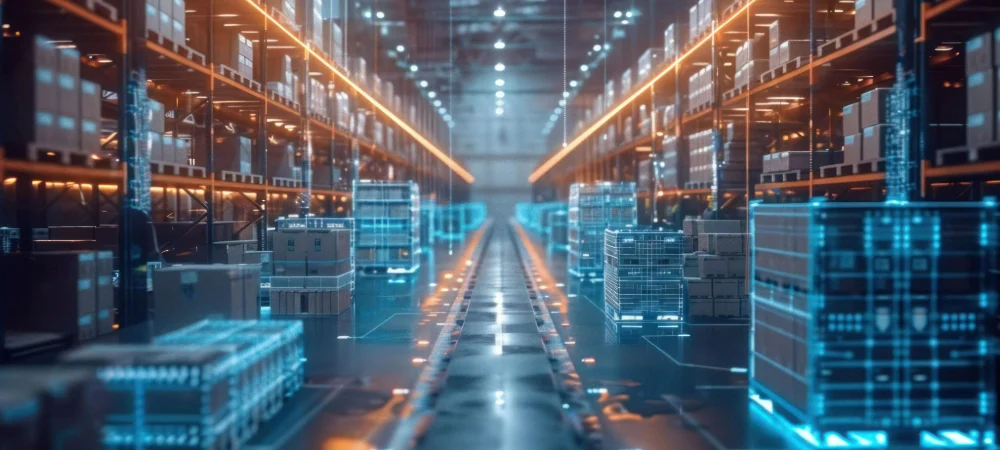
Unilever plans to deploy more than 40 AI-powered digital twins across its network over the next 18 months. These systems will allow teams to identify potential problems earlier, simulate alternative scenarios and make decisions before issues affect production.
The significance of this transition extends beyond introducing another generation of software tools.
“The biggest opportunity isn’t just deploying AI, it’s fundamentally redesigning our underlying processes so people and AI can work together effectively,” Cuthbert says.
That distinction could prove critical. Supply chains have traditionally been built around sequential processes, with forecasting, sourcing, production, logistics and retail operations functioning as connected but often separate disciplines.
AI creates the opportunity to link those processes far more closely.
A shift in consumer behaviour could influence a forecast, which could affect production requirements, material sourcing and logistics planning almost immediately. Digital twins could then model the manufacturing implications before physical changes are made.
The result is a supply chain that increasingly behaves as a connected digital system rather than a series of individual operations.
For Unilever, the prize is greater than efficiency alone. Better forecasting can reduce inventory, digital twins can cut waste and connected customer data can improve product availability.
More importantly, the same infrastructure can make the organisation more resilient when conditions change unexpectedly.
As global supply chains become more complicated and consumer expectations accelerate, the ability to anticipate what happens next is becoming a competitive advantage.
Unilever’s strategy suggests the future of supply chain management will therefore depend not simply on how much AI companies deploy, but on how effectively they combine technology, data and human judgement across the entire organisation.

