

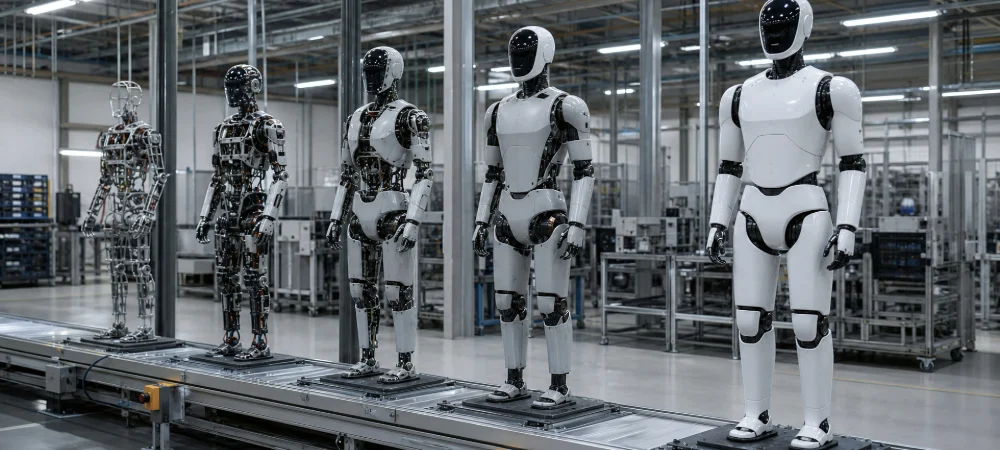
French robotics company Wandercraft is accelerating its push into industrial humanoid robots, securing 12 major customers in less than a year as Renault prepares to deploy 350 machines from 2027.
The company is scaling up its Physical AI technology through Calvin-40, an autonomous humanoid designed for heavy, repetitive work in factories and logistics facilities. Its new Paris headquarters, inaugurated on 5 October 2026, combines research and development, production and maintenance to support expansion.
Calvin can lift loads of up to 40 kg and perform tasks in some of industry’s hardest-to-fill positions. Operating without a teleoperator, the robot draws on Wandercraft’s 12 years of expertise in exoskeletons. A future version is expected to support loads of 50 kg.
Using 3D vision, autonomous navigation and adaptive control, Calvin perceives its surroundings and adjusts its movements to transport cartons and crates, handle heavy loads and move materials between workstations.
Wandercraft says the robot can operate within existing facilities without infrastructure modifications. The objective is to reduce physical strain on workers while allowing employees to concentrate on tasks requiring their expertise.
Developed on Wandercraft’s proprietary Physical AI platform, Calvin is benefiting from a partnership with Renault Group intended to accelerate industrialisation and large-scale production. Renault’s planned deployment provides an opportunity to demonstrate the technology in operational factory environments.
Matthieu Masselin, CEO and co-founder, Wandercraft, said: “We are now the global leader in our historic market. We are scaling up to become the global leader in humanoid robotics with 12 blue-chip clients signed in less than 12 months and 350 humanoid robots deployed next year.”
Wandercraft is expanding production capacity through its new 4,300 m² headquarters in Paris. The facility brings research and development, assembly and maintenance together, with 800 m² allocated to assembling, storing and maintaining robots.
The site has a stated production capacity of one robot per hour. Beyond that initial capacity, Wandercraft has set an ambitious longer-term target of manufacturing one million robots annually, supported by a production base intended to remain largely European and globally competitive.
The company’s industrial ambitions follow its announced acquisition of Ekso Bionics in October 2026, strengthening its position in medical exoskeletons, the market in which it established its business.
The acquisition expands Wandercraft’s presence in the United States and extends its work beyond rehabilitation centres into everyday personal mobility. Its Eve system is designed to help wheelchair users move around their homes.
Together, the Atalante X and EksoNR exoskeletons are used in more than 700 rehabilitation centres worldwide. This established medical robotics business provides the foundation for Wandercraft’s broader expansion into industrial humanoid systems.
The strategy links an established rehabilitation robotics business with a larger industrial manufacturing ambition. The immediate challenge is scaling from early customer commitments to sustained production, while proving that autonomous machines can handle demanding material movement tasks alongside existing factory teams without extensive site changes.

