

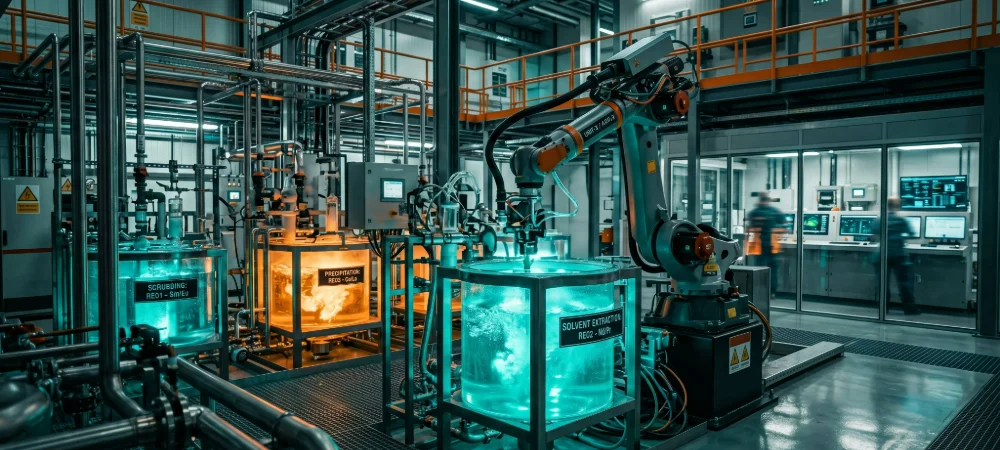
Aclara Resources and Argonne National Laboratory have completed the first stage of developing an AI-powered digital twin designed to accelerate US production of heavy rare earth materials and reduce dependence on Chinese processing capacity.
The Canadian mining technology company and the US Department of Energy laboratory have validated a computational model of the separation process planned for Aclara’s Project Dynamo facility in Vinton, Louisiana.
The model simulates 478 interconnected mixer-settler stages, predicting rare earth concentrations throughout the solvent extraction circuit. It was calibrated using operational data from Aclara’s demonstration plant in Virginia.
Rare earth separation remains a critical bottleneck in Western supply chains, with China controlling approximately 90% of global processing capacity.
Unlike conventional operating methods, which depend heavily on experienced technicians making cautious adjustments, the model allows engineers to test process changes virtually before implementing them.
The next development phase, under the Department of Energy’s Genesis Mission, aims to create a dynamic digital twin capable of predicting operational disturbances and supporting AI-generated recommendations.
Argonne’s high-performance computing infrastructure is expected to support simulations across hundreds of interconnected processing stages.
Aclara expects the technology to improve material recovery, reduce chemical consumption and accelerate production ramp-up.
However, the Genesis Mission award agreement remains under negotiation and commercial deployment is not guaranteed.
A subsequent phase could connect the digital twin directly to plant sensors and actuators, enabling automated adjustments.
The project represents an attempt to apply advanced computing to one of America’s most strategically sensitive industrial supply chains.

