

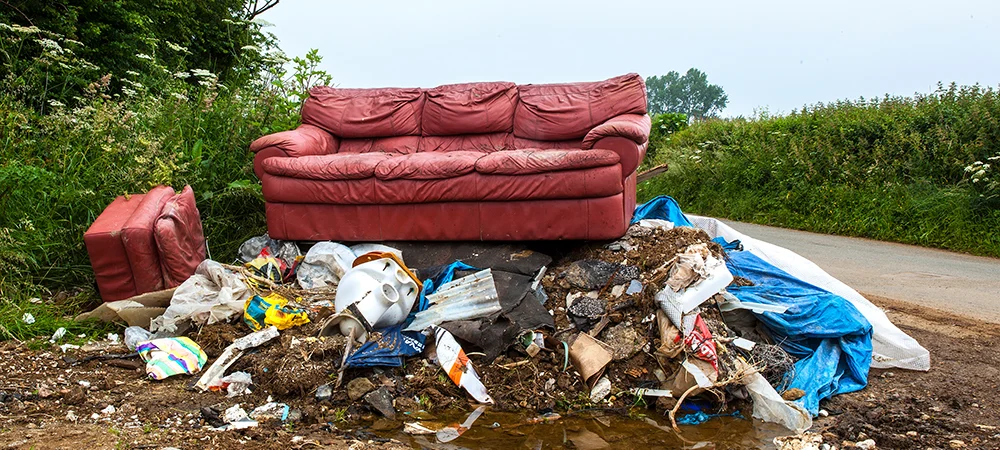
Britain’s growing fly-tipping crisis has ballooned into a £150-million problem, impacting almost every council across the nation; clogging up rural lanes, industrial estates and city parks. This week, new figures from environmental charity Keep Britain Tidy revealed that UK councils recorded more than one million fly-tipping incidents in 2023-24, an increase that has local authorities calling the situation ‘a national disgrace’.
Beyond the mess, the numbers sting. Councils estimate that cleaning up and investigating these offences drains between £100 million and £150 million from local budgets each year – money that could otherwise fund schools, libraries and care services.
But amid the anger, there’s an opportunity for a technological turning point. Councils, environmental agencies and tech start-ups are deploying a suite of innovations, from AI-powered cameras to blockchain waste tracking, to fight back. The battle against fly-tipping is fast becoming a showcase of how data and digital tools can modernise one of Britain’s dirtiest problems.
AI Cameras
Across the country, councils are installing AI-enabled CCTV towers to watch over fly-tipping hotspots. These units, often running on solar power and connected via 4G or 5G, use Machine Learning software to detect suspicious behaviour – like a van stopping in a lay-by late at night, doors opening and bulky items being unloaded. Within seconds, the system flags the footage to enforcement officers.
Some systems even integrate Automatic Number Plate Recognition (ANPR), logging vehicle details and linking them with DVLA data to identify offenders. This rapid response helps authorities act before evidence disappears and acts as a visible deterrent to would-be dumpers.
“AI cameras have changed the game,” said Paul O’Rourke, Waste Enforcement Manager for East Riding of Yorkshire Council. “We’re no longer reliant on chance sightings or next-day reports. The system notifies us in real time, and we can move fast.”
Companies like Clearway, WCCTV and Bi3 are leading the charge, offering mobile towers that councils can redeploy to new hotspots as needed. These systems can operate autonomously for weeks, using solar panels and remote connectivity. Some now feature thermal imaging and motion sensors, allowing detection even in unlit rural areas.
From hotspots to heatmaps
Behind the scenes, councils are embracing data analytics and mapping tools to make enforcement more strategic. Instead of blanket surveillance, they analyse patterns: time of day, vehicle types, recurring sites etc. and allocate resources to where they’re most effective.
Hull City Council, for instance, recently adopted a system that combines camera data with citizen reports to generate heatmaps of dumping activity. “It’s predictive policing for waste crime,” explains a spokesperson. “We can see when certain areas are at risk and deploy mobile cameras or patrols before the problem escalates.”
Machine Learning models are also helping identify repeat offenders. By matching vehicle plates, waste types and even the brands of packaging found in dumped material, enforcement teams can link incidents together and build stronger legal cases.
Citizen tech
While councils upgrade their surveillance networks, the public is playing a growing role through mobile reporting apps. Platforms like ClearWaste, FixMyStreet and Love Clean Streets allow residents to photograph fly-tipping, tag the location and submit it directly to local authorities.
These reports feed into the same analytics systems that track camera data, helping councils respond faster and build intelligence about problem zones. Crucially, they also close the loop: residents can see when their report has been investigated or cleared, restoring a sense of accountability.
“Public engagement is key,” said Martin Montague, founder of ClearWaste. “Technology gives people an easy, transparent way to report and track issues, and that builds trust with local authorities.”
The synergy between smart cameras, mobile apps and real-time analytics is creating a feedback loop that’s reshaping environmental enforcement.
Tackling organised waste crime
This week’s discussions around fly-tipping have also highlighted a darker, related issue: serious and organised waste crime. The House of Lords’ Environment and Climate Change
Committee has warned that criminal gangs are making ‘millions of pounds’ by running illegal waste sites, falsifying disposal records and mis-labelling hazardous waste to dodge landfill tax. Here too, technology is proving essential.
The UK Environment Agency and private partners are developing digital waste-tracking systems that follow every tonne of waste from collection to final treatment. Using secure databases, each transfer is logged and time-stamped, creating an immutable audit trail.
This transparency makes it harder for rogue operators to ‘lose’ waste in the system or forge documents. Trials under the Defra Digital Waste Tracking Service have already shown success in tracing construction waste and hazardous materials.
Meanwhile, inter-agency data platforms are being built to link the dots between suspicious operators, vehicle registrations and financial records. By using AI-assisted intelligence sharing, enforcement agencies can identify criminal networks that might have previously slipped through bureaucratic gaps.
Environmental monitoring
Technology isn’t just catching people in the act, it’s also revealing where damage is being done. Drones and satellite imagery are increasingly used to detect illegal waste sites in remote areas. By analysing changes in land texture, vegetation and thermal signatures, algorithms can flag suspicious sites long before human patrols would spot them.
In parts of the Midlands, for example, drones equipped with thermal cameras have uncovered hidden piles of construction waste and even buried chemical drums. AI models trained on these images help distinguish between legitimate land-use changes (like farm work) and illicit dumping.
Elsewhere, environmental monitoring companies are deploying sensor networks to detect contamination near rivers, reservoirs or farmland. These sensors track runoff chemicals and microplastics, alerting authorities to possible illegal waste or fly-tipping that’s polluting water sources.
The data-sharing revolution
A recurring theme across all these technologies is integration. The fight against waste crime depends on multiple bodies – local councils, the Environment Agency, police, private landowners – working together. Historically, data was fragmented. Now, systems are being connected.
The OECD recently published a report outlining how digital collaboration platforms allow enforcement agencies to pool evidence securely, cross-reference licences and co-ordinate prosecutions. As more councils adopt compatible systems, a national intelligence framework for waste crime is emerging.
This integration is also helping to target vehicle seizures, a new power under recent government reforms that allows councils to confiscate or even crush vehicles used in fly-tipping. ANPR data and cross-agency alerts ensure that repeat offenders don’t simply change postcodes to avoid penalties.
The future
Not all the tech focus is punitive. Some start-ups are reimagining waste itself as a digital opportunity.
AI-driven recycling systems are being tested to scan, sort and price waste automatically, reducing landfill pressure. In the future, these systems could link directly with the digital waste-tracking networks, ensuring materials are not only legally disposed of but efficiently reused.
Circular-economy platforms are also on the rise, connecting businesses that produce surplus materials with those that can reuse them, preventing potential fly-tipping before it happens. It’s the preventative side of tech innovation: stop waste from being waste.
Britain’s fly-tipping crisis has become a rallying point for smart-city technologies. From AI cameras and blockchain traceability to citizen apps and drones, a new ecosystem of digital tools is emerging to keep the country cleaner and greener.
If Britain can harness its technology as effectively as its outrage, the days of roadside sofas and midnight mattress dumpers may finally be numbered.

