


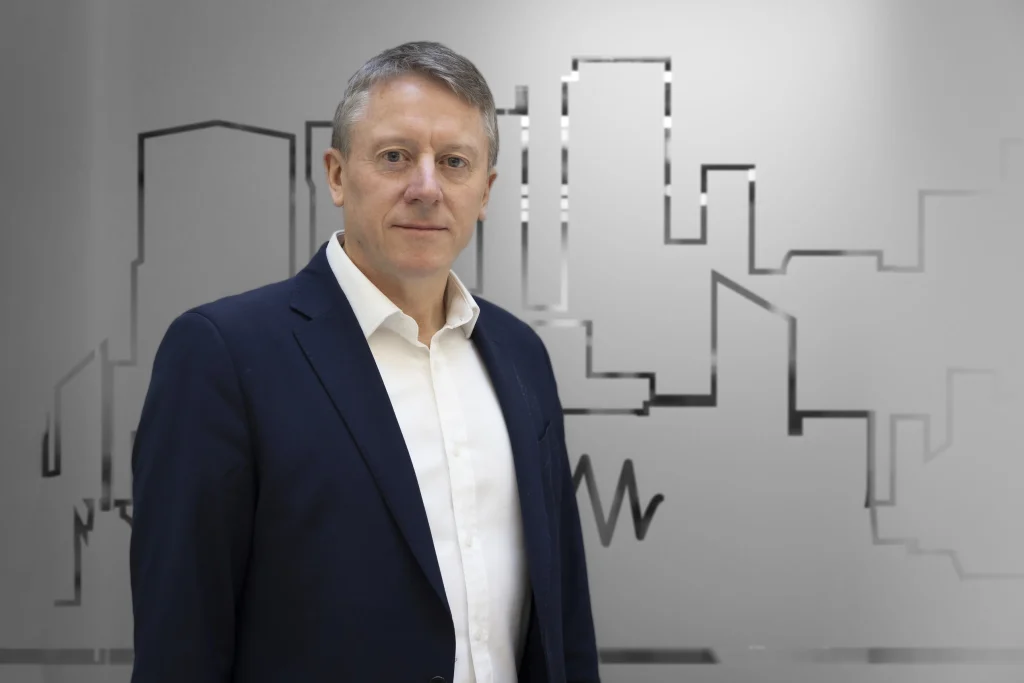
With AI-focused workloads driving power demands, data centres across the UK and Ireland are facing increasing constraints on power availability. Matthew Baynes, Vice President, Secure Power and Data Centres, UK and Ireland at Schneider Electric, highlights that resilient UPS systems and intelligent power distribution solutions are becoming critical to enabling sustainable growth in the evolving energy landscape.
As AI demand soars, so does the pressure on its infrastructure. Today, businesses and governments are seeking growth zones to scale AI’s evolution and the UK and Ireland are becoming the strategic choice. Yet without power, there is no compute and without compute, there is no AI. High‑density AI clusters are driving record demand for capacity, resilience and efficiency – pressuring power grids, extending connection queues and tightening net‑zero commitments. In this context, uninterruptible power supplies (UPS) and power distribution can no longer be considered as a back‑room engineering detail, but key strategic enablers of the future AI economy.
Escalating power density is at the heart of the AI scaling challenge. According to McKinsey, traditional racks averaging 8kW are rapidly being replaced by AI workloads consuming over 80kW, with roadmaps targeting 120kW and beyond. The electrical and thermal stress this places on the upstream infrastructure is significant, meaning it is no longer enough to think only in terms of total megawatts to site. Operators must now design power trains that can deliver very high and dynamic loads to specific clusters while maintaining overall resilience. At the same time, the cost and availability of energy are becoming obstacles for new development. The question has changed from ‘can we find a site?’ to ‘can we secure, move and condition enough power to make the site viable over its lifetime?’
UK market overview: Grid constraints and connection delays
This tension is heating up in the UK and Ireland. Demand for new capacity has surged around London and other secondary hubs just as transmission and distribution networks are wrestling with electrification of transport, heating and industry. Grid connection dates that once sat two to three years out can now fall well into the next decade and connection offers frequently arrive with constraints that force developers to rethink phasing, redundancy levels and even target customer mix. In response, the UK government has recognised the essential role of data centres, designating them as part of the country’s critical national infrastructure (CNI). This commitment has been reinforced through the AI Opportunities Action Plan where we have seen the emerging AI Growth Zones announced in Scotland, Wales and Northern England.
These constraints on the grid elevate the importance of efficient and flexible power distribution. Operators are pushing for architectures that minimise transformation steps, optimise losses at every stage and allow them to run closer to installed capacity without compromising resilience. Simultaneously, UPS architectures are increasingly becoming more flexible, modular and scalable, enabling operators to align deployment with real demand instead of building all resilience up front and carrying the efficiency penalty. Meanwhile, more attention is being paid to distribution topology; how power is segmented, which loads are prioritised under constraint and how quickly capacity can be reallocated between AI and non‑AI workloads as business priorities evolve.
Ireland: From moratorium to conditional expansion
Ireland offers a different but related picture to the UK. For years, the Dublin region has been a magnet for hyperscale investment, but long‑standing grid capacity issues led to congestion in the region and a de facto moratorium on many new data centre connections.
That approach is now being refined rather than reversed, shifting from a restrictive to conditional enablement of AI infrastructure. For instance, the Large Energy User Action Plan (LEAP) promotes the creation of ‘green energy’ parks in regional locations. These parks are designed to colocate energy-intensive industries with renewable energy sources, like offshore wind projects on the west coast.
This geographical change is designed to utilise underused parts of the national grid and spread the economic benefits of the tech sector evenly across the country. The framework entails strict conditions around on‑site generation, efficiency and flexibility, allowing operators to proceed where they can demonstrate that they will generate as much energy as they consume or materially support the stability of the grid. Leading operators like Digital Realty and Vantage Data Centers are adapting their strategies in line with these evolving requirements including greater emphasis on self-generation, renewable integration and resilient on-site power infrastructure.
This development in Ireland is and won’t be dissimilar to what many markets will face. Developers are exploring combinations of grid supply, large‑scale battery storage, small modular reactors and direct connections to renewable assets through private wires or long‑term power purchase agreements. The UPS is no longer simply a last line of defence against short‑term outages, it has become an active stabilising layer between multiple power sources and the IT load: capable of smoothing intermittency, participating in demand response and providing a ride‑through while engines or fuel cells ramp.
The architectural shift: From centralised power to distributed resilience
In the UK and Ireland, a broader shift is emerging away from purely centralised power trains towards more distributed, resilient designs. As stress increases on legacy power distribution models, the same happens for rack power densities. This leads to high‑density AI clusters benefitting from power islands that can be planned, built and upgraded semi‑independently within a campus. Modular UPS blocks, containerised switchgear and prefabricated power rooms support this efficient approach – enabling faster deployment and easier replication across sites. As microgrids and behind‑the‑meter generation become more common – whether that’s a renewable‑powered sovereign AI cloud in Argyll, or a campus colocated with wind and solar – the power distribution design must anticipate multiple operating modes from grid‑following, grid‑supporting and in some cases islanded operation for extended periods.
The rise of liquid cooling for AI adds another dimension. UPS systems need to support not only IT loads but also the pumps, controls and safety systems that keep solutions operating safely. Already in constrained regions, operators are beginning to prioritise workloads that can tolerate flexible operating envelopes, using power management and UPS orchestration to shape demand around grid or on‑site generation availability.
Industry response: Co-developing energy and digital infrastructure
Historically, data centre facilities were treated as passive consumers: they drew power, maintained their own resilience and had limited interaction with the grid beyond basic connection agreements. That model is changing. In the UK, system operators are now repurposing legacy power infrastructure sites and alongside regulators are increasingly looking to balance a system with higher levels of renewables such as solar farms. In Ireland, conditional permits explicitly encourage or require microgrid strategies including self‑generation, export of surplus power, or participation in ancillary services to reduce grid dependency – designing power distribution systems to enable scalability and AI-readiness.
Conclusion: Data centres as energy hubs
UPS and power distribution architectures sit at the centre of this sustainable and efficient energy ecosystem evolution. The AI era demands simultaneous development of digital capacity and energy infrastructure. UPS and power distribution architectures determine how flexibly a data centre can respond to price signals, grid events, or on‑site generation swings; how efficiently it can use every kilowatt it receives and how quickly it can scale new AI capacity without over‑investing in stranded infrastructure. For operators in the UK and Ireland, the path forward will be defined as much by decisions about electrical architecture as by choices of hardware or location. In the age of AI, UPS and power distribution are not simply protective layers, but the foundation on which the future of UK and Irish AI will stand.

