

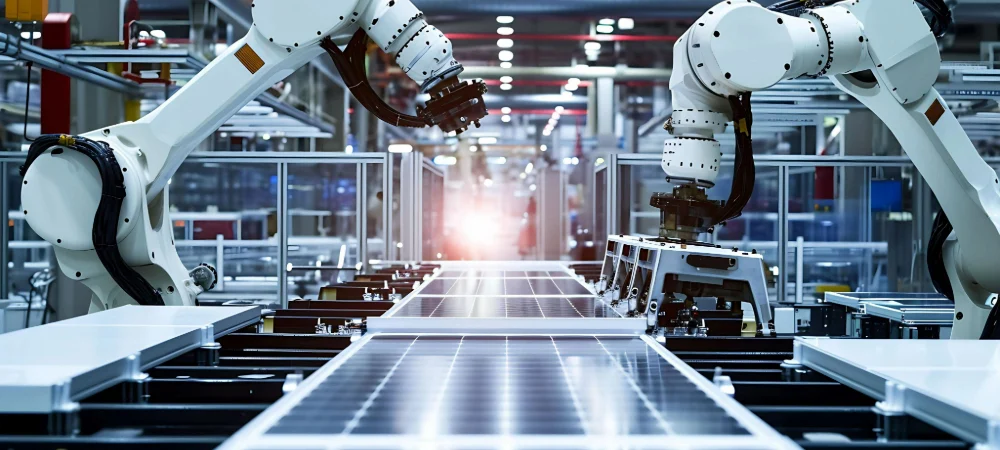
The rapid expansion of industrial and humanoid robotics could create a significant new source of global electricity demand, adding further pressure to power systems already being reshaped by artificial intelligence and data centre growth.
Research from Wood Mackenzie forecasts combined global robotics electricity consumption could reach 363 TWh annually by 2035, approaching the 373 TWh generated by France’s nuclear fleet in 2025.
The Embodied AI: How Robotics Are Accelerating Global Power Demand study estimates industrial robots will account for 357 TWh of that total, while humanoid robots could contribute another 6 TWh as deployments accelerate.
For energy planners, the findings suggest robotics could become another major infrastructure consideration alongside the rapidly increasing electricity requirements of AI computing.
Around five million industrial robots were operating globally in 2025, consuming an estimated 78 TWh of electricity annually. Wood Mackenzie said this was equivalent to around 20-25% of current global data centre power demand and almost twice London’s annual electricity consumption.
If the industrial robot fleet maintains its current annual expansion rate of around 12%, the number of operational machines could reach 16 million by 2035. Annual installations have already increased from approximately 200,000 in 2015 to 500,000 in 2025 and are forecast to exceed one million by 2032.
China dominates robotics deployment
China is emerging as the central force behind the expansion. The country accounts for more than 70% of annual global industrial robot installations, while Chinese companies were responsible for nearly 90% of humanoid robots deployed in 2025.
The scale of investment is extending robotics beyond manufacturing into critical infrastructure. China State Grid is spending US$1 billion during 2026 to acquire 8,500 AI-enabled autonomous robots capable of performing more than 600 specialised tasks.
Applications range from routine grid inspection and maintenance to live-line operations on ultra-high-voltage power infrastructure, demonstrating how autonomous machines could increasingly become embedded within energy networks themselves.
Humanoid robotics remains at a much earlier stage of commercial development but Wood Mackenzie expects deployment to accelerate rapidly. The research forecasts the global humanoid robot stock could grow at a compound annual rate of more than 90% between 2025 and 2035, exceeding 10 million units as annual shipments rise above four million.
Longer term, the implications for electricity systems could become substantially greater. If the global humanoid robot population eventually reaches one billion units by 2050, Wood Mackenzie estimates their electricity requirements alone could become comparable with South Korea’s entire 2026 power generation.
Falling hardware costs could help drive that expansion.
Average humanoid robot prices declined 93% between 2020 and 2025 to approximately US$58,000. China’s Unitree Robotics offers its G1 humanoid robot for around US$16,000, illustrating how rapidly the economics of embodied AI are changing.
Wood Mackenzie estimates a Unitree G1 operating eight hours per day would incur annual electricity costs of approximately US$82, based on an average global industrial electricity tariff of US$0.14 per kWh.
While humanoids remain limited in their capabilities and commercial applications, declining acquisition and operating costs could make deployments increasingly attractive for businesses confronting labour shortages, particularly in developed economies.
“Power constraints are becoming a real brake on robotic adoption, and that matters because labour markets in developed economies are running short of alternatives,” said Robert Liew, Director, Integrated Energy Research at Wood Mackenzie.
“Industrial robots already draw 78 TWh a year globally, and that is before humanoid robots reach any real scale. By 2035, combined demand could hit 363 TWh.”
A new challenge for power infrastructure
The emergence of robotics as a major electricity consumer comes as utilities, governments and technology companies are already attempting to accommodate unprecedented power requirements from AI infrastructure.
Data centre operators are seeking access to increasingly large blocks of electricity as hyperscale facilities and AI campuses expand. Robotics could add another distributed but substantial layer of demand across factories, logistics centres, warehouses, utilities and eventually workplaces.
Unlike data centres, where electricity requirements are concentrated at identifiable facilities, robotic power consumption could be spread across millions of individual machines and industrial locations. That could make future demand more difficult for utilities and policymakers to model.
Wood Mackenzie’s forecast indicates industrial robotics will remain overwhelmingly responsible for electricity consumption during the coming decade. However, the rapid development of humanoid systems means their contribution could become increasingly significant beyond 2035.
The convergence of AI, robotics and electrification therefore presents a wider infrastructure challenge. As intelligence moves beyond data centres and into physical machines, the energy requirements associated with AI will increasingly extend into factories, warehouses, transport systems and electricity networks.
For the technology industry, access to computing power may consequently represent only part of the infrastructure equation. Access to sufficient electricity could become equally important in determining how quickly embodied AI moves from experimental deployments to operation at global scale.

