

Kurt Semba, Senior Principal Software Systems Engineer, Extreme Networks, says AI is increasingly being used to optimise the data centres, networks and buildings that support it, helping organisations reduce energy consumption without compromising performance.
Artificial intelligence is often discussed for its potential to drive innovation and transform entire industries. But alongside the excitement, boardrooms and IT departments are increasingly talking about how to build the infrastructure that’s needed to power it.
Data centres now account for around 6% of electricity consumption in both the UK and the US, driven largely by the rapid growth of AI workloads. And for many organisations, access to enough power is becoming just as important as access to compute capacity.
But the same technology that’s driving that energy demand is also starting to help reduce it. Nowhere is this more apparent than in the data centre, network and buildings, where AI is being used to reduce energy consumption without compromising performance. In other words, AI is helping to optimise the very systems that support it.
Optimising the data centre
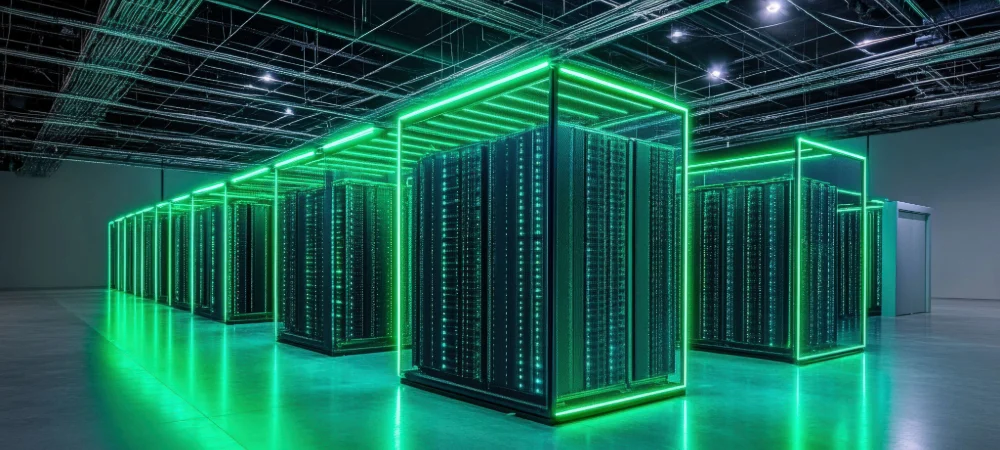
While AI workloads get all the attention for their compute needs, the cooling infrastructure that keeps these systems running is often where we can find one of the biggest opportunities for efficiency gains.
Cooling systems have traditionally been built with fixed rules to prevent overheating. These methods are effective but often use more energy than necessary. But AI-powered control systems that can analyse telemetry in real-time can predict cooling needs and dynamically adjust equipment to maintain stable temperatures while using less energy.
AI is also helping organisations rethink when workloads are run. Carbon-aware computing is on the rise as businesses use energy and carbon-intensity forecasts to schedule flexible workloads when renewable energy is most available.
Model training, batch analytics and non-urgent processing are examples of tasks that can often be shifted without impacting service levels, reducing costs and environmental impact.
These developments highlight the value of making better use of existing resources. Often, meaningful efficiency gains can be realised without sacrificing performance.
Building more energy-aware networks
The same opportunity is found in enterprise networks. Network infrastructure is generally built to accommodate peak demand, so large portions of the network are fully operational even in periods of low utilisation.
This overprovisioning is being addressed by advances in AI-powered network management. AI can analyse traffic patterns and usage trends and then automatically adjust network resources to meet demand.
During periods of lower activity, wireless access points, ports and links can be powered down, while critical services continue to run at full power. Idle radios can slip into a sleep mode and wake without impacting performance, while badge readers, cameras and safety systems remain prioritised after hours.
Mobile operators are already proving this works at scale. In London 5G trials, Vodafone UK and Ericsson used AI-driven orchestration to cut daily radio unit power by up to 33% with no degradation in user experience – a real field deployment, not a lab result. The principle is simple: capacity should be allowed to rest when demand does.
The result is a more dynamic network that consumes less energy without compromising on performance or the user experience. Capacity remains available while organisations avoid paying the price of constantly running everything at full power.
Energy efficiency is also being considered more, along with traditional priorities like availability, performance and security, as organisations work towards their sustainability goals.
Smarter buildings, lower consumption
The opportunity extends beyond traditional IT infrastructure. Commercial buildings consume significant amounts of energy through heating, cooling, ventilation and lighting systems, many of which continue to operate according to fixed schedules regardless of occupancy.
Intelligent building management platforms can use data from sensors, occupancy systems and weather forecasts to adjust environmental conditions in real time based on how spaces are actually being used.
Research from Lawrence Berkeley National Laboratory estimates that AI-enabled control alone can deliver 8–19% long-run energy reductions in commercial buildings, with heating and cooling consistently representing the biggest opportunity.
This allows organisations to offer comfortable working environments while eliminating unnecessary energy consumption. Buildings can adapt to actual usage patterns throughout the day, not assumptions about occupancy. The outcome is a workplace that is more efficient and embraces both sustainability objectives and the employee experience.
Right-sizing AI itself
One of the most overlooked opportunities lies within AI applications themselves. As organisations deploy large language models and AI-powered services, there is growing recognition that different use cases require different levels of computing power.
Many business applications can be supported by smaller, task-specific models that consume fewer resources while still delivering strong results. Techniques such as model optimisation and prompt efficiency can further reduce energy consumption without compromising on performance.
A 2025 analysis from UNESCO and UCL found that pairing compact, task-specific models with techniques such as quantisation and shorter prompts can dramatically reduce the energy consumed per query. It is the AI equivalent of swapping floodlights for LEDs – and switching them off when you leave the room.
By selecting the most appropriate model for each task, organisations can meet their business objectives while reducing the demands on their infrastructure and lowering their operating costs.
Balancing innovation and efficiency
Organisations are facing greater scrutiny regarding energy consumption and efficiency improvements, particularly within data centre environments.
This makes visibility more important than ever. Energy usage is increasingly becoming a strategic business metric that influences investment decisions and long-term growth. AI can play an important role by providing the visibility and predictive insights needed to identify efficiency opportunities across complex environments.
Whether applied to cooling systems, network infrastructure, buildings or AI workloads, intelligent optimisation can help organisations make better use of existing resources while supporting future growth. The ability to improve efficiency without sacrificing performance will become an increasingly important part of long-term technology strategy.

