

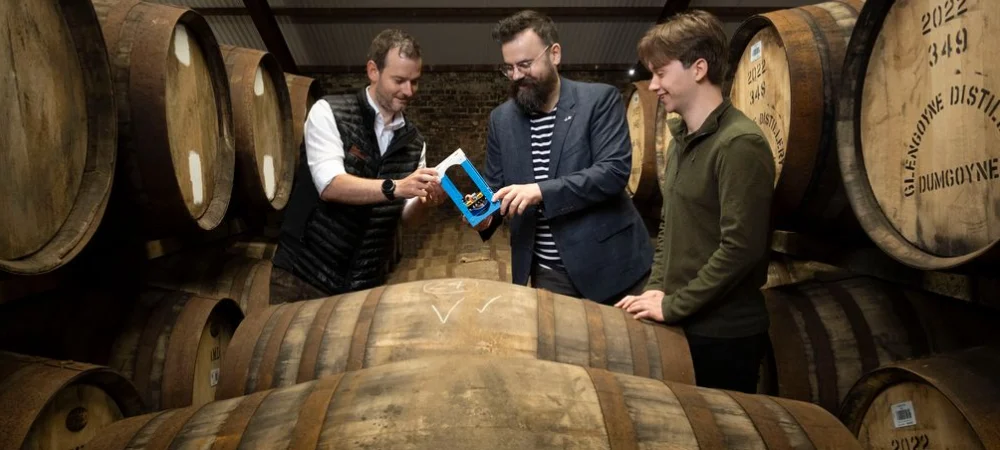
University of Glasgow and Kyushu Institute of Technology engineers are preparing to study how whisky compounds behave in space, with the experiment set to explore the potential of microgravity for future chemical and manufacturing applications.
Engineers from universities in Scotland and Japan are planning to boldly go where no dram has gone before with the launch of a new research project to distil whisky in space.
The researchers are planning to send whisky-making materials into space aboard a tiny satellite and use an artificial ‘tongue’ to taste tiny changes in the tipple’s terpenes as it orbits the Earth.
The project aims to test for the first time how the complex chemistry of whisky-making is affected by the harsh environment of space.
Their findings could help pave the way for orbital factories where molecules which are difficult or impossible to synthesise on Earth can be manufactured for use in new medications for conditions like diabetes, cancer and Alzheimer’s disease.
The technological foundations of the project are set to be laid this autumn, as seven final-year mechanical engineering students from the University of Glasgow join colleagues at Kyushu Institute of Technology in Japan.
The students recently arrived in Kyushu, where they will spend three months helping to co-design the system which will be sent into orbit, offering input into the battery, radio and onboard computers which will be at the heart of the spacecraft.
When the project is launched into space aboard a CubeSat in 2028 carrying 10ml of fluid, it will spend up to five years investigating how the distillation process works in orbit. On Earth, whisky is produced by mixing barley with water and yeast. Yeast breaks down the sugars in the barley, creating ethanol as a byproduct. The team’s system will demonstrate how ethanol, which plays a role in the production of many drugs, can be extracted in orbit.
Dr Gilles Bailet, of the University of Glasgow’s James Watt School of Engineering, is leading the project. His research includes the ongoing development of a 3D printer capable of building complex structures in space. His patented design has already shown encouraging results in low-Earth orbit and may help to build the orbital drug factories of the future.
Bailet said: “Previous research has suggested that the microgravity of space may allow us to grow larger, purer chemical crystals and to fold proteins in new ways. Big questions remain over how me might actually do chemistry in space, however and this project aims provide some answers.
“Whisky gives us a very recognisable, very well-understood model for studying and monitoring biological and chemical processes in microgravity. This project will provide valuable new insights into how fermentation and chemical evolution can be monitored and controlled in space, as well as how ethanol can be made in orbit.
“Our ultimate aim is that our project could help to scale up chemistry and biomanufacturing in space, where there is a great deal of potential to produce high-value pharmaceuticals and next-generation cancer therapeutics.”
Although samples of whisky and oak casks have been sent into space before, they were tested entirely onboard the International Space Station before being sent back to Earth. The Scotland-Japan collaboration’s project will mark the first time that whisky has been directly exposed to the vacuum of space.
A key component of the team’s kit is a nanophotonic ‘tongue’, previously developed by the University of Glasgow’s Dr Alasdair Clark, which enables rapid chemical sensing and will detect changes in the composition of the whisky sample in orbit.
A second strand of the experiment will use the tongue to monitor how a fragment of whisky cask wood reacts to rapidly changing extremes of heat and cold as it circles the Earth in 90-minute cycles. The team expects the wood to ‘breathe’ far faster than it ever could on the ground, potentially opening an entirely new way to study and even accelerate the maturation process.
The initial visit to Japan is the result of a grant from distillery-design consultancy Allen Associates. The development of the project is also being supported by student societies at the University of Glasgow, including GU Orbit, which provides opportunities for students to gain hands-on experience in space-related projects and competitions.
Glasgow engineering student Micah Chapman is one of the team who has begun work on the project in Japan. He said: “More than a century ago, a Japanese student called Masataka Taketsuru came to Glasgow to study chemistry. While he was here, he visited distilleries and returned to Japan with a detailed knowledge of whisky-making. He began work at a distillery and became world-famous as the father of Japanese whisky.
“I’m thrilled to have this opportunity to be part of another project which unites Scotland and Japan in an effort to change the world through the chemistry of whisky. It’s fantastic to have the chance to work on a project that will be launched into space and I’m excited have this opportunity to work and learn at Kyushu Institute of Technology.”
Chapman is being joined on the trip by fellow students Liam Alkire, Fraser Allen, Milo Godwin, Peter Moody, Yuki Suter and Muhammad Taha Malik.
Bailet sees the cross-cultural project as an opportunity to unite engineering with the arts to deepen the students’ appreciation of both. The students received lessons in Japanese language and culture from researchers at the University of Glasgow’s College of Arts & Humanities in preparation for their trip.
Bailet said: “I’m very grateful to my colleagues in the University and to Allen Associates for their support so far, which has enabled this first step towards putting our project into space and will provide invaluable experience for the students who are taking part.
“For many years now, talented students who want to build a career in space have often felt they have to leave Scotland to do it, heading to England or overseas and often never coming back.
“By training the next generation of space engineers here and getting their hardware into orbit before they even graduate, we can keep that talent at home and feed it straight into Scottish companies and start-ups. This project is one small part of a much bigger effort to establish Scotland as a serious player in the global space sector, a place you don’t have to leave in order to reach space.”
Geoff Nisbet, Lead Process Design Engineer at Allen Associates, said: “We often say that our fingerprints are found all over Scotland’s distilleries, we never expected the next set might end up in space.
“We’re delighted to support a project which brings together Scotland’s world-renowned whisky industry, engineering innovation and the next generation of engineers. There is also something quite fitting about Scotland and Japan being brought together through whisky once again, this time with a project looking far beyond the distillery itself.
“The collaboration between the University of Glasgow and Kyushu Institute of Technology gives the students a fantastic opportunity to work internationally, share ideas and take a little bit of Scotland’s distilling expertise into space along the way.”
Dr Mariko Teramoto of the Kyushu Institute of Technology said: “Our Cuket educational programme gives students practical experience in developing small satellites, from design and construction to testing. For this project, Kyutech will develop the satellite bus and its own mission instruments, while the University of Glasgow will develop the whisky experiment. The Glasgow students will also contribute ideas and feedback to Kyutech on the satellite bus design.
“Bringing these elements together requires close collaboration between our teams. We hope students will learn not only how to develop their own systems, but also how to exchange ideas and work with international partners to make a shared space mission possible. This is an exciting opportunity to combine our strengths and build a lasting partnership in space research and education.”
Dr Saeko Yazai, of the University of Glasgow’s School of Critical Studies, said: “I was very happy to organise a Japan orientation session for the project team in collaboration with various University colleagues who have connections with Japan, as well as the Consulate General of Japan in Edinburgh.
“Scotland has a rich and strong record of relations with Japan which go back at least to the 19th century. A number of Scottish engineers, scholars and businessmen played an important role in the modern history of Japan and many Japanese students, who studied at Glasgow, rose to prominent positions on their return, including Masataka Taketsuru.
“The strong links between Glasgow and Japan can be also seen in the arts, including the Glasgow Boys and Charles Rennie Mackintosh, who were inspired by Japanese art. So, I’m very excited to play a part in this Scotland-Japan collaborative project, and hope that the 160-year long history between the two countries will grow in the future.”

